
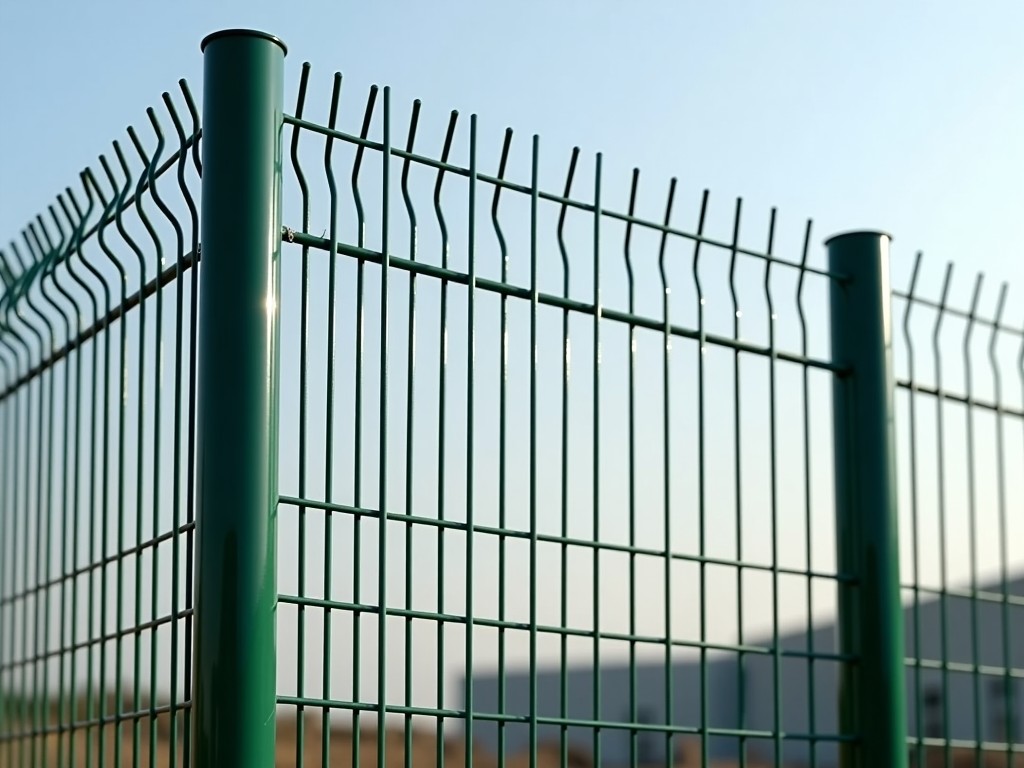
Wholesale Durable Wire Mesh Fence Factory
Wire mesh fence panels serve as barriers for perimeter security, livestock containment, and site delineation across industrial, agricultural, and municipal sectors. The factory specializes in
Wholesale Durable Wire Mesh Fence Factory
Product Overview
Wire mesh fence panels serve as barriers for perimeter security, livestock containment, and site delineation across industrial, agricultural, and municipal sectors.
The factory specializes in wholesale production of mesh systems that emphasize uniform tensile strength and resistance to environmental degradation.
Customers receive standardized rolls or panels ready for immediate installation upon delivery.
Material Composition
Core wire is typically low‑carbon steel, selected for its balance of ductility and strength before any surface treatment.
Depending on the required service life, the wire undergoes hot‑dip galvanizing, electrolytic zinc coating, or a polymer overlay such as PVC or PE.
Coating thickness is controlled to meet ISO 1461 for galvanization or ASTM D1186 for polymeric layers, ensuring consistent barrier performance.
Technical Specifications
| Property | Typical Value | Unit |
|---|---|---|
| Wire Diameter | 2.0 – 4.0 | mm |
| Mesh Opening | 50 × 50 – 100 × 100 | mm |
| Roll Width | 1.0 – 2.5 | m |
| Roll Length | 10 – 50 | m |
| Coating Thickness (Galvanized) | 55 – 85 | µm |
| Tensile Strength (Wire) | 350 – 550 | MPa |
Manufacturing Process
Wire is drawn to the target diameter, then straightened and cut to length before being woven on automated looms that interlock each strand at precise intervals.
After weaving, the mesh passes through a cleaning station to remove oxides, followed by a coating line where either molten zinc or polymer is applied under controlled temperature and speed.
Finished rolls are tension‑tested, cut to standard lengths, and wrapped for protection against mechanical damage during handling.
Performance Characteristics
The combination of steel core and protective coating yields a fence that resists rust formation for extended periods, even in humid or saline environments.
Tensile strength of the wire ensures the mesh can withstand impact loads from animals or equipment without permanent deformation.
Flexibility of the woven structure allows the fence to conform to uneven terrain while maintaining barrier integrity.
Typical Applications
- Industrial facility perimeters where unauthorized entry must be deterred.
- Agricultural fields for livestock containment and crop protection.
- Municipal projects such as park boundaries, sports fields, and public utility sites.
Customization Options
Wire diameter, opening size, and roll dimensions can be adjusted to match specific load or spacing requirements.
Coating type—galvanized, zinc‑aluminum alloy, or PVC—is selected based on expected exposure to chemicals, UV radiation, or abrasion.
Additional features such as selvage edges, reinforced corners, or pre‑drilled post holes are available upon request.
Quality Assurance
Each production lot undergoes visual inspection for coating uniformity and mesh integrity before leaving the line.
Mechanical tests verify tensile strength and elongation against the specifications listed in the technical table.
Documentation including mill test certificates and coating thickness reports is provided with every shipment.
Packaging and Shipping
Rolls are wrapped in protective polyethylene film and secured with strapping to prevent shifting during transit.
Standard palletization facilitates handling with forklifts or pallet jacks, reducing the risk of product damage.
For export orders, the factory uses ISPM‑15 compliant wooden pallets and includes moisture‑absorbent desiccants to guard against corrosion.
Frequently Asked Questions
- Can dimensions be customized?
- Yes, wire gauge, opening size, roll width, and length are adjustable according to project specifications.
- What information is required before quotation?
- Required details include desired mesh opening, wire diameter, coating type, total length or area, and any special features such as selvage treatment.
- How is quality inspected?
- Inspection includes visual coating checks, dimensional verification, and tensile testing of random samples from each batch.
- What packaging methods are available?
- Standard packaging uses polyethylene film and strapping on pallets; custom crating or container loading can be arranged.
- What is the typical production lead time?
- Lead time varies with order size and coating selection, generally ranging from 2 to 4 weeks after receipt of confirmed specifications.