
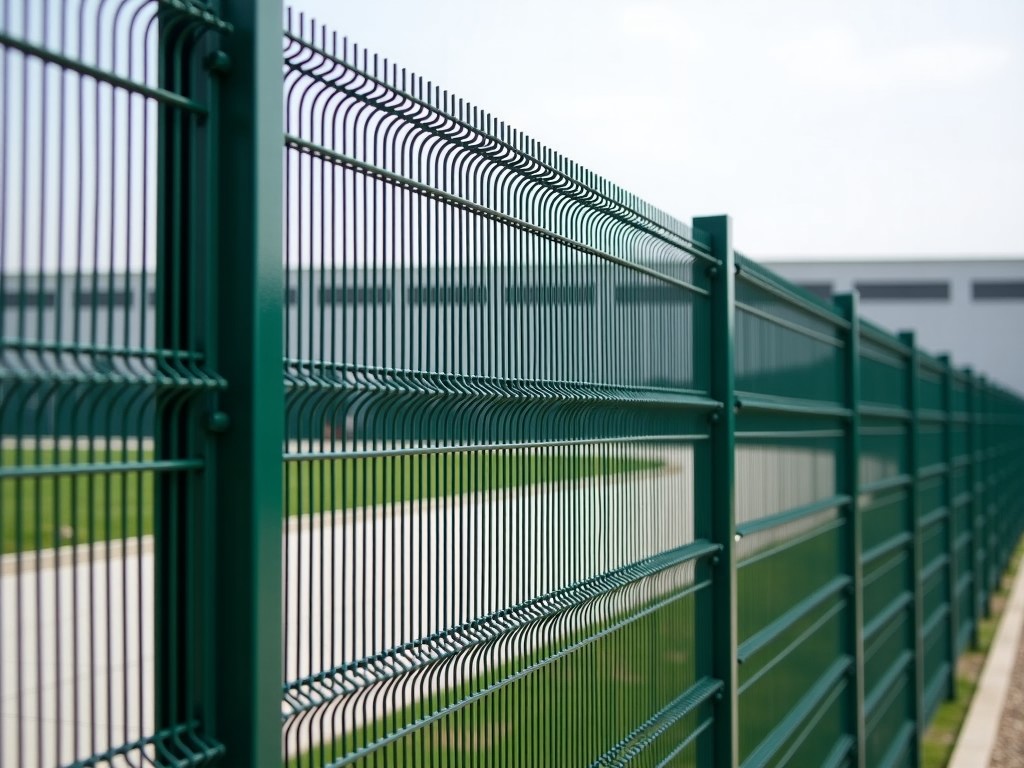
Factory Direct Wire Mesh Security Cage Fence Panels Exporter
Wire mesh security cage fence panels are prefabricated barriers formed by welding steel wire into a grid and attaching it to a rigid frame. They are used where a secure perimeter is required while
Factory Direct Wire Mesh Security Cage Fence Panels Exporter
Wire mesh security cage fence panels are prefabricated barriers formed by welding steel wire into a grid and attaching it to a rigid frame. They are used where a secure perimeter is required while maintaining visibility, airflow, and light transmission. The panels are shipped directly from the manufacturer to international buyers, eliminating intermediate handling.
Material and Construction
The core material is low‑carbon steel wire, typically drawn to diameters between 2.5 mm and 4.0 mm. Welding is performed at each intersection using resistance spot welding, which creates a joint with tensile strength comparable to the parent wire. After welding, the panel undergoes a protective coating process; common options are hot‑dip galvanization (zinc coating ≥ 60 µm) or a polyvinyl chloride (PVC) over‑coat for additional chemical resistance. The frame that surrounds the mesh can be formed from cold‑rolled angle steel, square tubular steel, or extruded aluminum, depending on load requirements and corrosion expectations.
Technical Specifications
| Parameter | Typical Value | Notes |
|---|---|---|
| Panel Height | 2.4 m | Custom lengths available up to 3.5 m |
| Panel Width | 1.2 m | Standard module; can be joined for longer runs |
| Mesh Opening | 50 mm × 50 mm | Other apertures (25 mm, 75 mm) possible |
| Wire Diameter | 3.0 mm | Range 2.5 mm–4.0 mm |
| Frame Material | Cold‑rolled angle steel 40 mm × 40 mm | Square tube or aluminum on request |
| Coating Type | Hot‑dip galvanized (Zn ≥ 60 µm) | PVC over‑coat available |
| Estimated Service Life | 15–20 years in mild‑corrosion environments | Dependent on coating and exposure |
| Wind Load Resistance | Up to 150 Pa (based on standard panel) | Higher resistance with reinforced frame |
Typical Applications
Factories and warehouses use these panels to create secure storage yards, equipment enclosures, and personnel walkways. The open mesh design allows CCTV cameras and light fixtures to remain unobstructed while preventing unauthorized entry. In detention or correctional facilities, the same panels provide a climb‑resistant barrier that still permits visual supervision. Agricultural operations employ them for livestock pens where airflow and visibility are essential for animal health.
Customization Options
- Panel dimensions – height, width, and length can be adjusted to match site layout.
- Mesh aperture – smaller openings for increased climb resistance, larger for better visibility.
- Wire gauge – thicker wire for higher impact loads, thinner for weight savings.
- Coating – galvanization thickness, PVC color, or powder‑coat finishes.
- Frame geometry – angle, square tube, round tube, or extruded aluminum.
- Mounting hardware – base plates, post brackets, quick‑release clamps.
- Gate integration – single‑leaf, double‑leaf, sliding, or panic‑bar configurations.
Quality Control Philosophy
Each production batch undergoes a sequence of checks before packaging. Dimensional verification is performed with calibrated gauges to confirm height, width, and squareness within ± 2 mm. Weld integrity is assessed by pull‑testing a sample of spots; the required minimum shear strength is 80 % of the wire’s tensile capacity. Coating thickness is measured with a magnetic‑induction gauge; galvanized layers must meet the declared micron value. Final visual inspection looks for surface defects, missed welds, or coating holidays. Only panels that satisfy all criteria are released for shipment.
Packaging and Export Logistics
Finished panels are stacked flat, separated by corrugated cardboard sheets to prevent surface abrasion. The stack is then wrapped in shrink‑film and secured to a wooden pallet with steel straps. For container shipments, pallets are arranged to maximize vertical stacking while keeping the centre of gravity within safe limits. Each pallet carries a clear label showing part number, quantity, coating type, and destination port. Export documentation includes a commercial invoice, packing list, and, upon request, a certificate of coating compliance.
Frequently Asked Questions
- Can the panel dimensions be customized? Yes, height, width, and length are adjusted per project specifications; custom tooling may be required for non‑standard sizes.
- What information is needed to obtain a quotation? Required data include desired panel size, mesh opening, wire diameter, coating type, frame material, quantity, and delivery destination.
- Which materials are available for the frame? Standard offerings are cold‑rolled angle steel and square tubular steel; aluminum and stainless steel are available upon request.
- How is coating quality verified? Coating thickness is measured on‑site with a magnetic‑induction gauge; adhesion is checked by cross‑cut testing according to ASTM D3359.
- What packaging methods protect the panels during transit? Panels are interleaved with cardboard, shrink‑wrapped, and strapped to pallets; corner protectors are added for extra edge safety.
- What is the typical production lead time? Lead time ranges from 15 to 30 working days after receipt of confirmed drawings, depending on complexity and current schedule.
- Are samples available for evaluation? Yes, a single‑panel sample can be shipped; the customer covers sample preparation and freight costs.
For a detailed quotation or to discuss specific project requirements, please contact our export team.
Request a Quote