
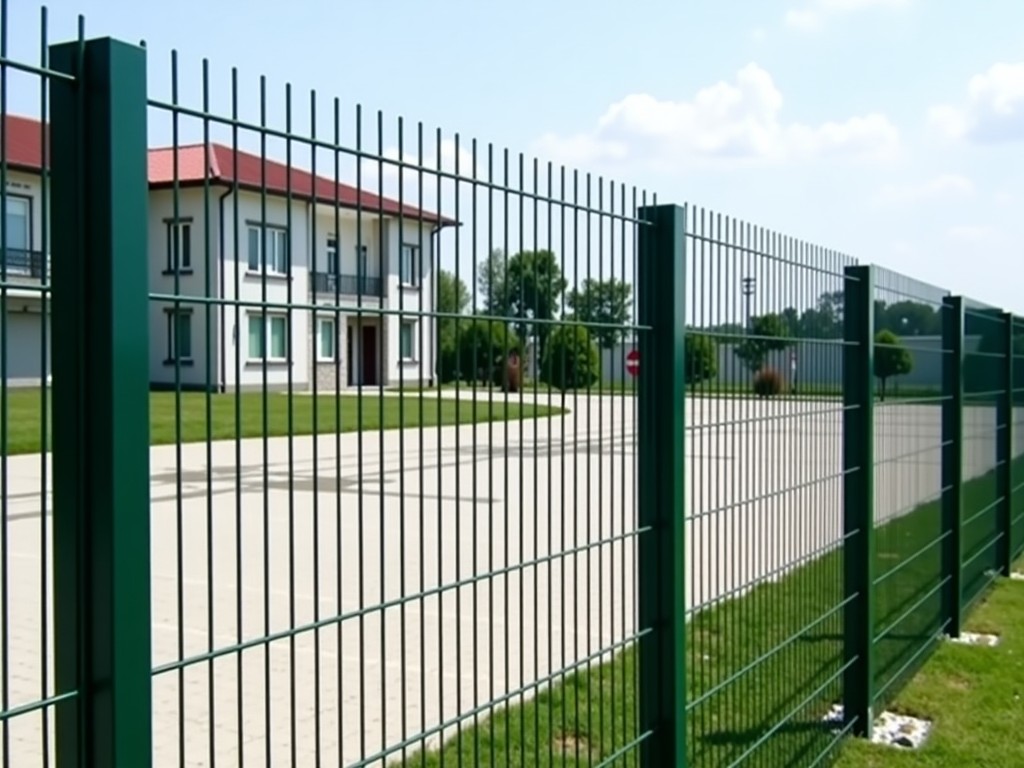
Custom Metal Wire Mesh Fence Manufacturer
When specifying perimeter security for industrial sites, the wire mesh fence must balance structural strength, corrosion resistance, and ease of installation. Engineers evaluate wire diameter,
Custom Metal Wire Mesh Fence Manufacturer
When specifying perimeter security for industrial sites, the wire mesh fence must balance structural strength, corrosion resistance, and ease of installation. Engineers evaluate wire diameter, opening geometry, and coating type to predict service life under specific environmental loads.
A manufacturer that offers custom dimensions, material grades, and finishing options allows the specifier to match the fence performance to site‑specific criteria such as wind load, impact exposure, and chemical exposure.
Material Options
The base wire determines mechanical properties and corrosion behavior. Commonly used alloys include low‑carbon steel, galvanized steel, stainless steel (grades 304 and 316), and aluminum‑magnesium alloy.
- Low‑carbon steel: economical, requires protective coating for outdoor use.
- Hot‑dip galvanized steel: zinc coating thickness typically 55‑85 µm provides barrier protection.
- Stainless steel 304: suitable for moderate chloride environments; 316 adds molybdenum for marine exposure.
- Aluminum‑magnesium alloy: lightweight, intrinsic corrosion resistance, tensile strength ~200 MPa.
Typical Material Specifications
| Material | Wire Diameter (mm) | Opening Size (mm) | Tensile Strength (MPa) | Corrosion Resistance* |
|---|---|---|---|---|
| Low‑carbon steel | 2.0 – 4.0 | 25 – 100 | 350 – 550 | Requires coating |
| Hot‑dip galvanized steel | 2.0 – 4.0 | 25 – 100 | 350 – 550 | Good (zinc 55‑85 µm) |
| Stainless steel 304 | 2.0 – 4.0 | 25 – 100 | 520 – 720 | Moderate chloride |
| Stainless steel 316 | 2.0 – 4.0 | 25 – 100 | 520 – 720 | High chloride / marine |
| Aluminum‑magnesium alloy | 2.0 – 4.0 | 25 – 100 | 200 – 300 | Intrinsic resistance |
*Corrosion resistance is qualitative; actual performance depends on coating thickness, environment, and maintenance.
Manufacturing Process
Wire is drawn to the target diameter, then welded or woven into the desired mesh pattern. Welded mesh provides uniform opening dimensions and higher shear resistance, while woven mesh offers flexibility for impact absorption.
After forming, the mesh undergoes cleaning, surface treatment (galvanizing, powder coating, or passivation), and final inspection. Dimensional tolerances are typically held to ±2 mm on panel width and height, and ±0.5 mm on wire diameter.
Post‑treatment curing temperatures for powder coating range from 160 °C to 200 °C, ensuring film thickness of 60‑120 µm for adequate barrier protection.
Customization Choices
Beyond material selection, customers can specify panel geometry, edge finishing, and mounting hardware to meet site constraints.
- Panel dimensions: width 0.5 m to 3.0 m, height 0.5 m to 3.5 m (custom lengths available).
- Edge options: folded, capped with PVC strip, or welded frame for added rigidity.
- Mounting: post‑set brackets, clamp‑on systems, or pre‑drilled holes for bolt‑to‑concrete.
- Coating colors: standard RAL shades or custom powder‑coat hues.
Applications
Industrial facilities choose wire mesh fences when visibility, airflow, and light transmission are required alongside perimeter security.
- Warehouse yards: allows security cameras to see through while deterring unauthorized entry.
- Power substations: provides clearance for heat dissipation and reduces wind loading compared to solid panels.
- Transportation terminals: maintains sightlines for passenger flow and vehicle movement.
- Agricultural enclosures: contains livestock while permitting ventilation and sunlight.
Quality Control Philosophy
Each production lot undergoes visual inspection, dimensional verification, and coating thickness measurement. Non‑destructive testing such as magnetic flux leakage is applied to welded joints to detect missed welds.
Mechanical proof tests are performed on a sample basis: tensile strength of wire is verified per ASTM A370, and peel adhesion of coating per ASTM D4541.
Traceability is maintained through lot numbers that link raw material certification, process parameters, and final inspection results, facilitating root‑cause analysis if a field issue arises.
Frequently Asked Questions
Yes. Panel width, height, opening size, and wire diameter are adjusted according to project drawings; standard tooling accommodates ranges noted above.
Project layout, required panel quantities, material grade, coating type, edge finish, and any special tolerances or certifications.
Visual check, dimensional gauges, coating thickness gauge (magnetic or eddy‑current), and sample tensile/adhesion tests per relevant ASTM standards.
To protect the finish, panels are stacked with interleaving polyethylene sheets, wrapped in shrink film, and placed on pallets with corner guards to prevent coating damage during transit.
To discuss your specific fence requirements, request a detailed quote, or obtain sample panels, please reach out.
Contact Us for a Quote