
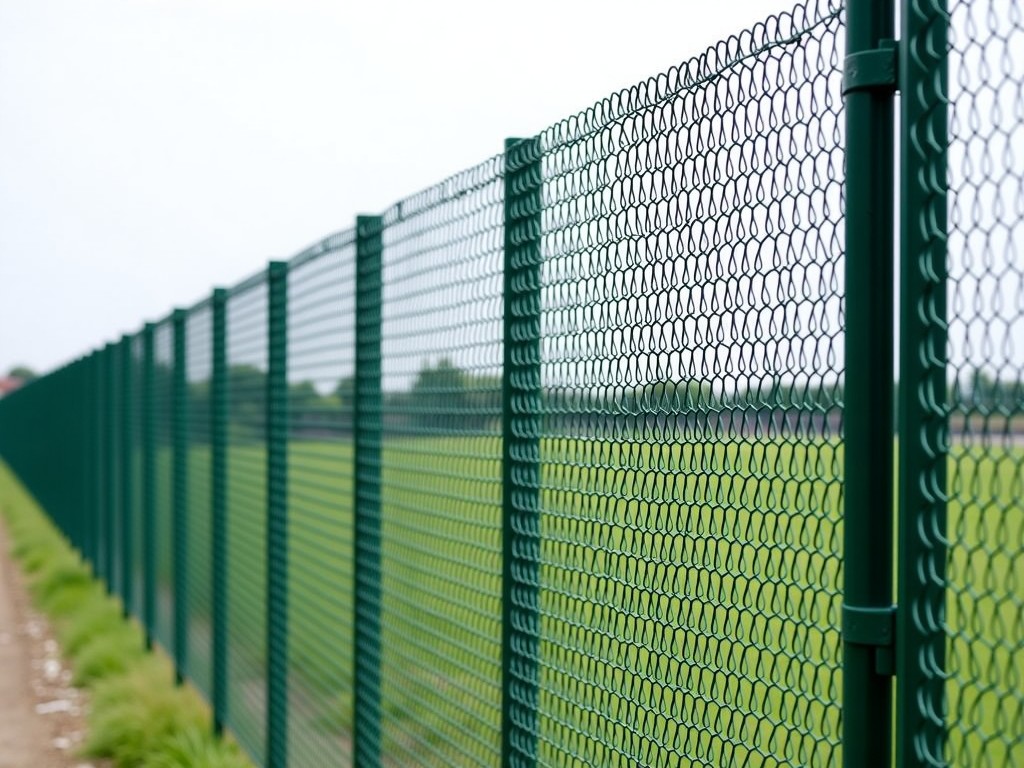
China Galvanized Chain Link Fence Panels Supplier
Galvanized chain link fence panels consist of woven steel wire mesh coated with a protective zinc layer, providing resistance to corrosion in outdoor environments. The panels are typically supplied
China Galvanized Chain Link Fence Panels Supplier
Galvanized chain link fence panels consist of woven steel wire mesh coated with a protective zinc layer, providing resistance to corrosion in outdoor environments. The panels are typically supplied in standard heights and widths, with options for varying mesh opening and wire diameter to meet specific load and security requirements. Understanding the dimensional and material characteristics helps procurement engineers assess suitability for perimeter, industrial, or agricultural applications.
Technical Specifications
Key parameters that define panel performance include height, width, wire gauge, mesh opening, and coating weight. These values influence tensile strength, deflection under load, and service life. The following table outlines typical ranges; exact figures can be adjusted according to project requirements.
| Parameter | Typical Value | Unit |
|---|---|---|
| Panel Height | 1.2 – 2.4 | m |
| Panel Width | 2.0 – 3.0 | m |
| Wire Diameter | 2.0 – 4.0 | mm |
| Mesh Opening | 50 × 50 – 100 × 100 | mm |
| Zinc Coating Weight | 200 – 350 | g/m² |
| Tensile Strength of Wire | 350 – 550 | MPa |
Material & Construction
The base wire is low‑carbon steel, drawn to the specified diameter before weaving. After forming the mesh, the panels undergo hot‑dip galvanization, where immersion in molten zinc creates a metallurgical bond that coats all surfaces, including the woven intersections. This process yields a uniform coating thickness that protects against rust for decades in most climates. Post‑galvanizing, panels may be optionally topped with a polymeric powder coat for added UV resistance or aesthetic color.
Typical Applications
Chain link fence panels are selected where visibility, airflow, and rapid installation are required. In industrial facilities they delineate storage yards while allowing surveillance cameras and light to pass through. Agricultural installations use them to contain livestock without obstructing pasture growth. Transportation corridors employ panels as glare‑reducing barriers that maintain sight lines for drivers. The open‑grid design also facilitates easy integration of barbed wire or privacy slats when higher security is needed.
- Industrial perimeter security
- Livestock containment and pasture division
- Highway and railway right‑of‑way fencing
- Sports field and recreational area enclosures
Customization Options
Suppliers can adjust panel dimensions, wire gauge, and mesh opening to match specific load calculations or aesthetic preferences. Lengths are typically limited by handling equipment, but panels can be fabricated in modular sections that splice on‑site using tension bars and bolts. Coating alternatives include hot‑dip galvanization followed by a polyvinyl chloride (PVC) overlay for environments with high chemical exposure. Additionally, posts, rails, and accessories such as tension wires, tie‑wires, and gate frames can be sourced to create a complete fencing system.
Quality Control & Testing
Manufacturers verify wire diameter using calibrated micrometers and check coating mass with magnetic‑induction gauges according to ISO 1461 or ASTM A123 standards. Mesh opening uniformity is assessed by sampling multiple panels and measuring aperture dimensions with calibrated gauges. Tensile strength of the wire is validated via pull‑to‑failure tests on representative samples. Visual inspection ensures the weld points (if any) and woven intersections are free of missed spots or drips that could compromise corrosion resistance.
Packaging & Logistics
Finished panels are stacked flat on pallets, separated by corrugated cardboard or plastic sheeting to prevent surface abrasion. Each pallet is secured with stretch wrap and steel bands to withstand handling during container loading. For overseas shipments, panels may be placed in ventilated crates to reduce moisture buildup. Standard containerization allows 20‑ft or 40‑ft loads, with typical lead times ranging from 2 to 4 weeks after order confirmation, depending on volume and customization level.
Frequently Asked Questions
- Can dimensions be customized? Yes, panel height, width, wire diameter, and mesh opening can be adjusted to project specifications; tooling changes may affect lead time.
- What information is required before quotation? Required details include desired panel size, wire gauge, mesh opening, coating type, quantity, and delivery destination.
- How is quality inspected? Incoming wire is tested for diameter and tensile strength; finished panels undergo coating thickness measurement and visual inspection per international standards.
- What packaging methods are available? Standard packaging uses palletized flat stacks with stretch wrap; custom crating or container‑specific packaging can be arranged.
- How are export shipments protected? Panels are interleaved with protective layers, secured with straps, and shipped in ventilated containers to limit condensation.
For detailed specifications, pricing, or to discuss a custom fencing solution, please reach out to our technical team.
Request a Quotation