
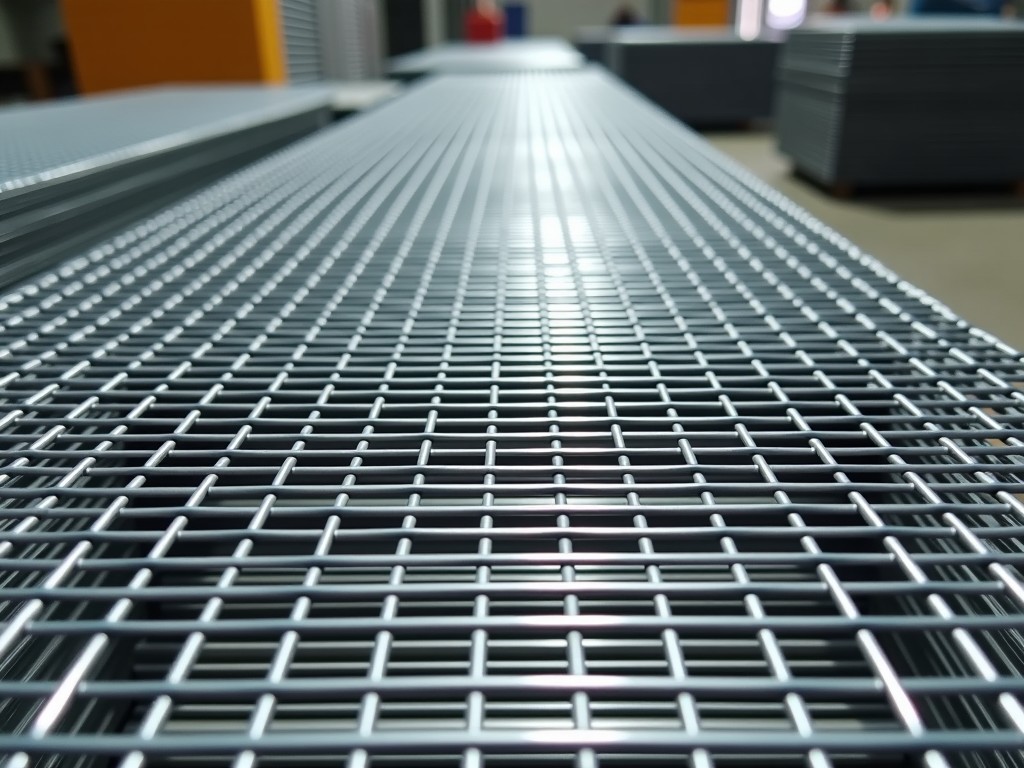
Ce Certified Galvanized Wire Mesh Factory
Galvanized wire mesh is produced by drawing low‑carbon steel wire to the desired diameter, weaving it into a regular grid, and then applying a zinc coating through hot‑dip galvanizing. The CE marking
CE Certified Galvanized Wire Mesh Factory
Product Overview
Galvanized wire mesh is produced by drawing low‑carbon steel wire to the desired diameter, weaving it into a regular grid, and then applying a zinc coating through hot‑dip galvanizing. The CE marking confirms that the product satisfies the essential requirements of the applicable EU directives (e.g., Machinery Directive, Low Voltage Directive where relevant) and may be placed on the market in the European Economic Area.
Our production line is equipped with continuous wire drawing machines, precision weaving looms, and a controlled galvanizing bath, allowing us to maintain tight tolerances on wire diameter, mesh opening, and coating weight from coil to coil.
Technical Specifications
The following table lists typical values for our standard galvanized wire mesh. All parameters can be adjusted to meet specific project requirements; exact figures are confirmed during the quotation stage.
| Parameter | Typical Range | Notes |
|---|---|---|
| Wire diameter | 0.8 mm – 4.0 mm | Custom diameters available on request |
| Mesh opening (square) | 6 mm – 100 mm | Other shapes (rectangular, hexagonal) can be manufactured |
| Roll width | 0.5 m – 3.0 m | Standard widths; custom slitting possible |
| Tensile strength of wire | 350 MPa – 550 MPa | Depends on wire grade and cold‑work level |
| Zinc coating weight | 100 g/m² – 275 g/m² | Measured per EN ISO 1461; thicker coatings for harsh environments |
Materials and Coating Process
We use low‑carbon steel wire grades such as SAE 1006/1008, which provide good ductility for weaving and sufficient strength for end‑use loading. The wire is first cleaned via alkaline degreasing and acid pickling to remove oxides and lubricants.
After cleaning, the wire passes through a flux bath (typically zinc ammonium chloride) to prevent oxidation during immersion. It is then dipped into a molten zinc bath at approximately 450 °C. The immersion time and withdrawal speed are controlled to achieve the target coating weight, after which the mesh is air‑cooled or optionally passivated with a chromate‑free sealant.
Quality of the galvanized layer is verified by measuring coating thickness with a magnetic inductance tester and conducting adhesion tests (e.g., knife‑scratch) in accordance with EN ISO 1461.
Manufacturing Considerations
Wire drawing tension is monitored to avoid micro‑cracks that could reduce fatigue life. The weaving loom operates at a calibrated pick density to ensure uniform mesh opening; deviations are corrected in real time using optical sensors.
Post‑galvanizing, the mesh undergoes a straightening pass to eliminate residual curl from the weaving process. Rolls are then wound with a controlled tension to prevent telescoping or edge damage during storage and transport.
All critical process parameters (drawing speed, loom speed, bath temperature, immersion time) are logged and traceable to each production batch, supporting both internal audits and customer requests for documentation.
Quality Assurance and Testing
Our quality management system follows ISO 9001 principles. Incoming wire is inspected for diameter tolerance, tensile strength, and surface finish before it enters the production line.
In‑process checks include mesh opening measurement via laser scanning, coating weight verification using the gravimetric method, and visual inspection for defects such as missed spots or excessive drips.
Finished rolls are subjected to a pull‑out test on a sample length to confirm the integrity of the welds at intersecting wires, and a salt‑spray test (ASTM B117) may be performed upon request to demonstrate corrosion resistance for specific environments.
CE Certification Details
The CE mark affixed to our galvanized wire mesh indicates compliance with the relevant European Union directives that apply to the product type. For wire mesh used in construction, machinery guards, or fencing, the applicable directives may include:
- Machinery Directive 2006/42/EC (when the mesh forms part of a safety guard)
- Low Voltage Directive 2014/35/EU (if used in electrical enclosures)
- Construction Products Regulation (EU) No 305/2011 (when incorporated into permanent works)
Our technical file contains the risk assessment, design calculations, test reports, and a Declaration of Conformity. The documentation is kept available for inspection by market surveillance authorities for at least ten years after the product is placed on the market.
Note that the CE marking does not replace any national or industry‑specific certifications that may be required for particular end‑uses; it serves as a baseline conformity indicator within the EEA.
Typical Applications
Galvanized wire mesh is selected when a combination of mechanical strength, corrosion resistance, and open area is required. Below are representative sectors where our product is commonly integrated.
- Concrete reinforcement – used as a secondary reinforcement layer in slabs, walls, and precast elements to control cracking and improve impact resistance.
- Machine guarding – provides a rigid barrier that meets ISO 13857 requirements for preventing access to moving parts while allowing visibility and airflow.
- Agricultural fencing and animal enclosures – the zinc coating extends service life in outdoor environments exposed to moisture, soil, and UV radiation.
- Industrial filtration and screening – selected mesh apertures enable separation of particulates in liquid or gas streams while maintaining structural integrity under pressure.
- Architectural cladding and façades – offers a lightweight, durable infill panel that can be painted or left exposed for aesthetic effect.
Each application imposes specific demands on mesh opening, wire diameter, and coating weight; our engineering team reviews these parameters during the quotation phase to ensure suitability.
Customization Options
We tailor the following attributes to match project specifications:
- Wire diameter (0.8 mm – 4.0 mm)
- Mesh shape and opening size (square, rectangular, hexagonal, custom patterns)
- Roll width and length (slit to customer‑defined dimensions)
- Zinc coating weight (light commercial to heavy‑duty)
- Post‑treatment options (chromate‑free passivation, PVC coating, powder coating)
- Edge treatment (selvedge, knuckle, twisted, welded)
Customization requests are accompanied by a technical data sheet that outlines the adjusted tolerances, expected performance, and any impact on lead time or pricing.
Packaging and Logistics
Finished rolls are wrapped in polyethylene film to protect against surface abrasion and moisture ingress during transit. The film is secured with UV‑stable strapping, and each roll is labeled with product code, dimensions, batch number, and CE mark.
For full‑container loads, rolls are placed on pallets with corner protectors and stretch‑wrapped. Less‑than‑container loads are packed in sturdy cardboard sleeves or wooden crates, depending on the destination’s handling requirements.
We provide standard export documentation (commercial invoice, packing list, certificate of origin, and CE Declaration of Conformity) and can arrange for additional certifications such as EN 1090 or ASTM equivalents upon request.
Frequently Asked Questions
Can dimensions be customized?
Yes. Wire diameter, mesh opening, roll width, and length can be adjusted to meet specific project requirements. Custom shapes and edge treatments are also available.
What information is needed before a quotation?
Please provide the intended application, required wire diameter, mesh opening size, roll dimensions, coating weight class, quantity, and any special packaging or documentation needs.
Which materials are available for the wire core?
We primarily use low‑carbon steel grades such as SAE 1006/1008. Higher‑strength alloys or stainless steel can be sourced upon request, subject to lead time and cost implications.
How is quality inspected?
Incoming wire is checked for diameter and tensile strength. In‑process controls monitor mesh opening, coating weight, and visual defects. Final inspection includes pull‑out tests and, if required, salt‑spray corrosion testing.
What packaging options are available?
Standard packaging consists of PE film wrapping with strapping. Additional options include cardboard sleeves, wooden crates, palletizing with corner protectors, and custom labeling.
How are export shipments protected?
Rolls are wrapped to resist moisture and abrasion, secured with UV‑stable straps, and placed on pallets with corner protectors. For ocean freight, we use desiccant packs and ensure proper ventilation in containers.
What is the typical production lead time?
Lead time depends on order size and customization level. Standard specifications usually ship within 2–3 weeks after order confirmation; customized orders may require 4–6 weeks.
How are samples arranged?
Samples of standard specifications can be dispatched within 3–5 business days. For customized samples, please contact our sales team to discuss feasibility and timing.