
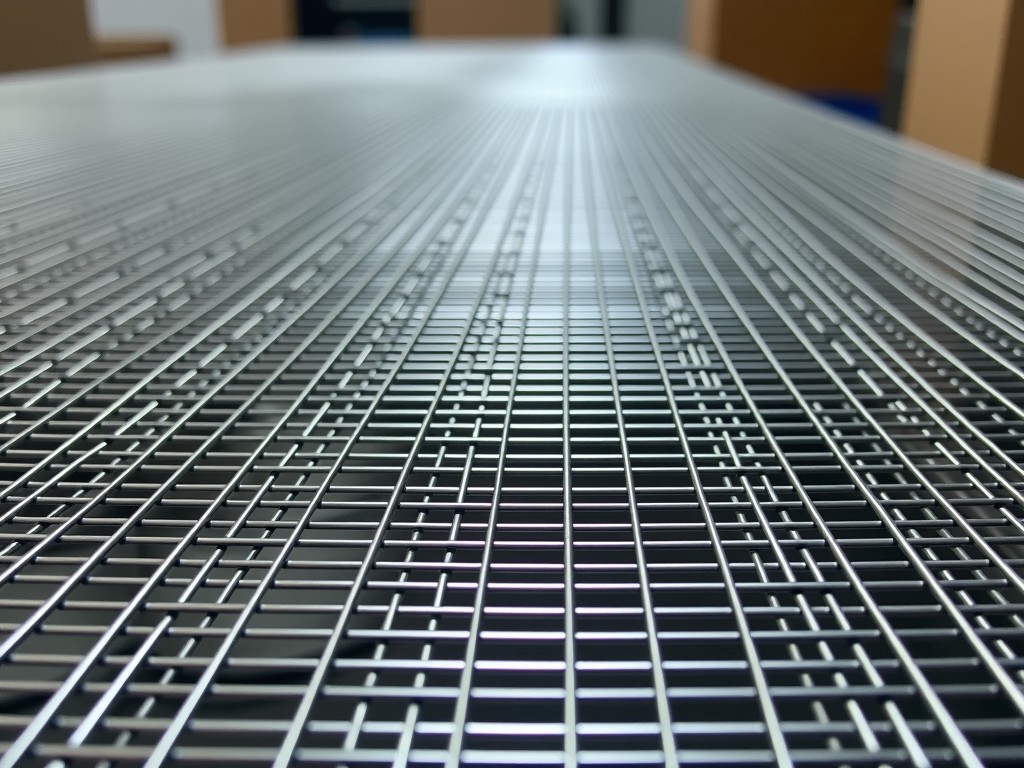
Bulk Wire Net Custom Manufacturer
Wire netting is produced by weaving or welding steel wire into a grid pattern with defined opening dimensions. The geometry of the mesh determines load distribution, ventilation, and barrier
Bulk Wire Net Custom Manufacturer
Wire netting is produced by weaving or welding steel wire into a grid pattern with defined opening dimensions. The geometry of the mesh determines load distribution, ventilation, and barrier performance in industrial environments.
Manufacturers adjust wire diameter, tensile strength, and surface treatment to meet specific mechanical and corrosion requirements. Understanding these variables allows engineers to specify a net that performs reliably over its service life.
Material Options and Mechanical Properties
- Low‑carbon steel wire (C ≤ 0.20 %) – typical tensile strength 350–450 MPa, suitable for general purpose enclosures.
- Galvanized steel wire (Zn coating 10–20 µm) – provides corrosion resistance equivalent to 5‑year service in mild atmospheres.
- Stainless steel wire (AISI 304) – tensile strength 500–700 MPa, resistant to chloride exposure up to 200 ppm.
- PVC‑coated wire – adds a 0.25 mm polymer layer, increasing abrasion resistance and providing electrical insulation.
Selection depends on the environmental exposure class defined in ISO 9223 and the required safety factor for static loads.
Customization Parameters
Customers specify the following variables to tailor the wire net to a particular application:
- Wire diameter: 0.8 mm to 6.0 mm (increments of 0.1 mm).
- Opening size (clear gap): 5 mm to 150 mm, square or rectangular.
- Panel dimensions: width up to 3000 mm, length up to 6000 mm (seamless rolls available).
- Edge treatment: selvage, welded border, or folded hem.
- Surface finish: plain, galvanized, stainless, or PVC coated.
These parameters are entered into a CAD‑driven nesting program that optimizes material usage while maintaining structural integrity.
Manufacturing Process Overview
Wire is first drawn to the specified diameter and then passed through a cleaning line to remove oxides. For galvanized product, the wire passes a hot‑dip zinc bath at 450 °C, followed by air‑cooling to achieve a uniform coating thickness.
The cleaned wire is fed into a computerized weaving loom or a resistance‑welding machine. Loom speed and tension are controlled to keep opening variance within ±0.5 mm. Welding parameters (current, time, pressure) are set to produce a shear strength of at least 90 % of the parent wire tensile strength.
After forming, panels undergo a straightening roller set to eliminate curl, then are cut to length using a shear with ±1 mm tolerance.
Quality Control and Testing
Each production lot is sampled according to ISO 2859‑1 (AQL 0.65 for critical dimensions). The following inspections are performed:
- Wire diameter verification with a micrometer (±0.01 mm).
- Opening size measurement using a calibrated gauge block.
- Tensile strength test on a sample wire strand (ASTM A370).
- Coating thickness measurement (magnetic induction) for galvanized wire.
- Visual inspection for weld defects, broken wires, or surface damage.
Results are recorded in a traceable batch record; any lot exceeding the AQL is segregated for rework or scrap.
Typical Applications
In mining operations, wire nets with 2 mm diameter and 25 mm openings serve as rockfall barriers, absorbing kinetic energy through controlled deformation.
Food processing plants use PVC‑coated nets with 1 mm wire and 10 mm openings as conveyor guards, providing a non‑contaminating surface that resists cleaning agents.
Architectural façades employ stainless steel nets (3 mm wire, 50 mm opening) as sunshades, where the high corrosion resistance ensures a service life exceeding 25 years in coastal environments.
Specification Table
| Parameter | Typical Range | Unit |
|---|---|---|
| Wire Diameter | 0.8 – 6.0 | mm |
| Opening Size (clear gap) | 5 – 150 | mm |
| Tensile Strength (wire) | 350 – 700 | MPa |
| Coating Thickness (Zn) | 10 – 20 | µm |
| Panel Width (max) | 3000 | mm |
| Panel Length (max) | 6000 | mm |
Values shown are typical; actual specifications are adjusted per project requirements.
Frequently Asked Questions
Can dimensions be customized?
Yes. Wire diameter, opening size, panel width and length, and edge treatment are all defined by the customer’s drawing or specification sheet.
What information is required before quotation?
A sketch or CAD file showing desired opening pattern, overall dimensions, wire material preference, and any required surface finish.
How is quality inspected?
Each lot undergoes dimensional checks, tensile testing, and coating thickness measurement per ISO and ASTM standards, with results retained for traceability.
What packaging methods are available?
Nets are rolled on a core with protective polyethylene film, then placed in corrugated cartons or wooden pallets, with corner protectors and strapping to prevent deformation during transit.
What is the typical production lead time?
Lead time ranges from 10 to 25 working days, depending on order complexity and material availability.