
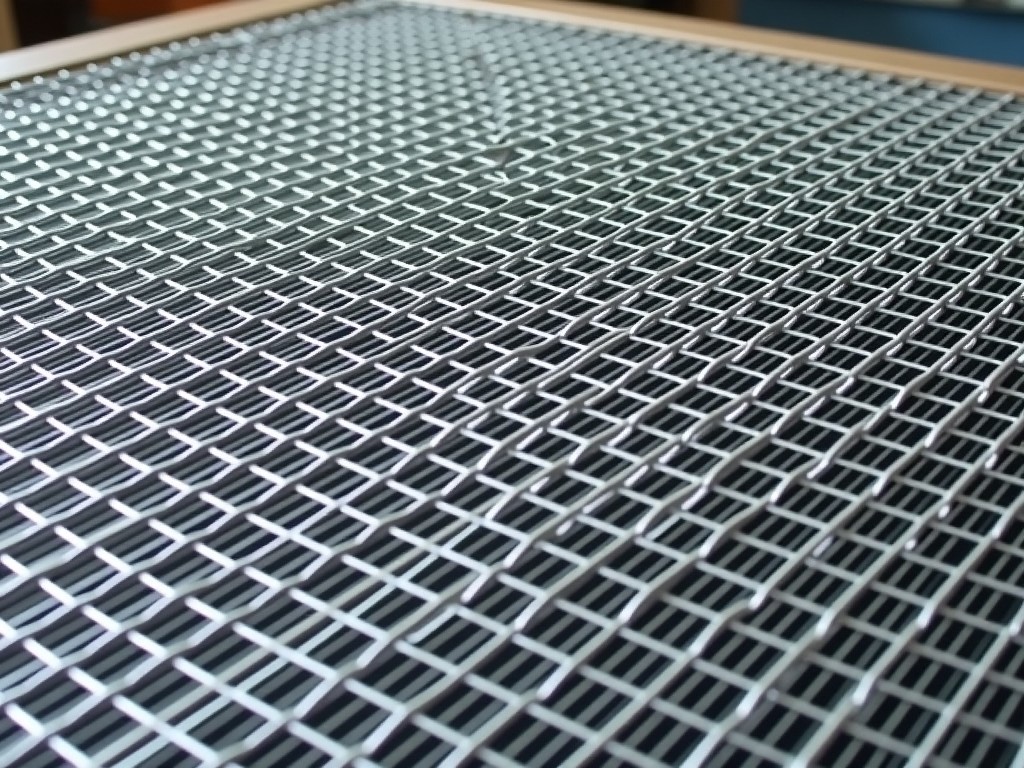
Bulk Wire Mesh Panels Wholesale Supplier
Wire mesh panels are fabricated assemblies of intersecting wires forming a regular grid. They serve as protective barriers, screening media, reinforcement layers, or conveyor surfaces in sectors
Bulk Wire Mesh Panels Wholesale Supplier
Wire mesh panels are fabricated assemblies of intersecting wires forming a regular grid. They serve as protective barriers, screening media, reinforcement layers, or conveyor surfaces in sectors ranging from mining to food processing. Understanding the engineering parameters that define these panels helps buyers assess suitability for specific operational demands.
Material and Construction Characteristics
Typical base materials include low‑carbon steel (ASTM A36), stainless steel grades 304 and 316L, and hot‑dip galvanized steel. Wire diameters commonly range from 0.8 mm for fine filtration to 5.0 mm for heavy‑duty guarding. Aperture (opening) sizes vary from 4 mm × 4 mm up to 100 mm × 100 mm, enabling precise control of open area percentage. Tensile strength of the wire typically falls between 380 MPa and 620 MPa depending on alloy and cold‑work level.
Standard Panel Dimensions and Tolerances
Manufacturers often stock panels in widths of 1.0 m, 1.2 m, and 1.5 m with lengths up to 6.0 m. Thickness (overall wire bundle depth) is dictated by wire diameter and mesh count, usually between 2 mm and 12 mm. Dimensional tolerances are held to ±2 mm on length and width, while wire diameter is controlled to ±0.05 mm. Edge finishes may be left raw, flattened, or fitted with a steel frame for added rigidity.
Mechanical Performance and Environmental Resistance
Open area percentage, a key design metric, is calculated as (opening area / total panel area) × 100 and can range from 15 % for tight meshes to over 80 % for coarse screens. Corrosion protection is achieved via hot‑dip galvanizing, producing a zinc coating thickness of 60 µm to 80 µm, or via PVC coating adding a 0.2 mm polymer layer. Panels intended for high‑impact service may undergo stress‑relief annealing to improve ductility while retaining yield strength above 250 MPa.
Typical Applications Explained
- In mining operations, panels with 6 mm × 6 mm apertures and 3 mm wire diameter act as screen media for ore sizing, providing high wear resistance under abrasive loads.
- Food‑processing facilities frequently specify 304 stainless steel mesh with 2 mm × 2 mm openings and 1.2 mm wire to prevent contamination while allowing easy cleaning and compliance with hygiene standards.
- Agricultural fencing uses galvanized panels of 50 mm × 50 mm aperture and 4 mm wire to contain livestock, offering a balance of visibility and structural integrity against wind loads.
- Construction sites employ welded mesh panels with 100 mm × 100 mm openings as temporary concrete formwork, where the open area facilitates rapid concrete pour and release.
Quality Control and Testing Procedures
Incoming wire is inspected for diameter consistency using laser micrometers, with acceptance criteria of ±0.02 mm. Finished panels undergo visual examination for weld integrity, followed by dimensional verification on a coordinate measuring machine. Tensile tests on extracted wire samples confirm conformity to specified strength ranges. Coating thickness is measured via magnetic induction, ensuring galvanized layers meet the 60‑80 µm target. All test results are retained for traceability and supplied to customers upon request.
Customization Options
Buyers may specify aperture shape (square, rectangular, hexagonal) to match flow dynamics or particle size requirements. Edge treatments include framing with C‑channel or angle steel, welding of peripheral ribs, or adding a flush‑mounted handle panel for manual handling. Surface treatments extend beyond galvanizing to include epoxy powder coating (thickness 80‑120 µm) for chemical resistance, or a black oxide finish for reduced glare in optical applications.
Packaging and Logistics
Panels are stacked flat on heat‑treated pallets, separated by corrugated cardboard layers to prevent surface abrasion. Each pallet is secured with polypropylene strapping and covered with UV‑stabilized shrink film. Standard container loading accommodates up to 24 pallets per 40‑foot unit, optimizing freight cost. For overseas shipments, desiccant packs are included to mitigate moisture ingress during transit.
Frequently Asked Questions
- Can dimensions be customized? Yes, panel width, length, and aperture can be tailored to project specifications; tooling adjustments are discussed during quotation.
- What information is required before quotation? Required details include wire material, diameter, aperture size, panel dimensions, edge finish, and any coating or treatment preferences.
- How is quality inspected? Inspection covers wire diameter, tensile strength, aperture uniformity, coating thickness, and visual weld integrity per ISO 9001‑aligned procedures.
- What packaging methods are available? Options include palletized flat stacks, crate‑packed for high‑value items, or bulk‑loaded in specialized wire reels for continuous mesh.
Request a Quote
To discuss your specific requirements for bulk wire mesh panels, provide the technical parameters outlined above and our engineering team will return a detailed quotation within two business days.