
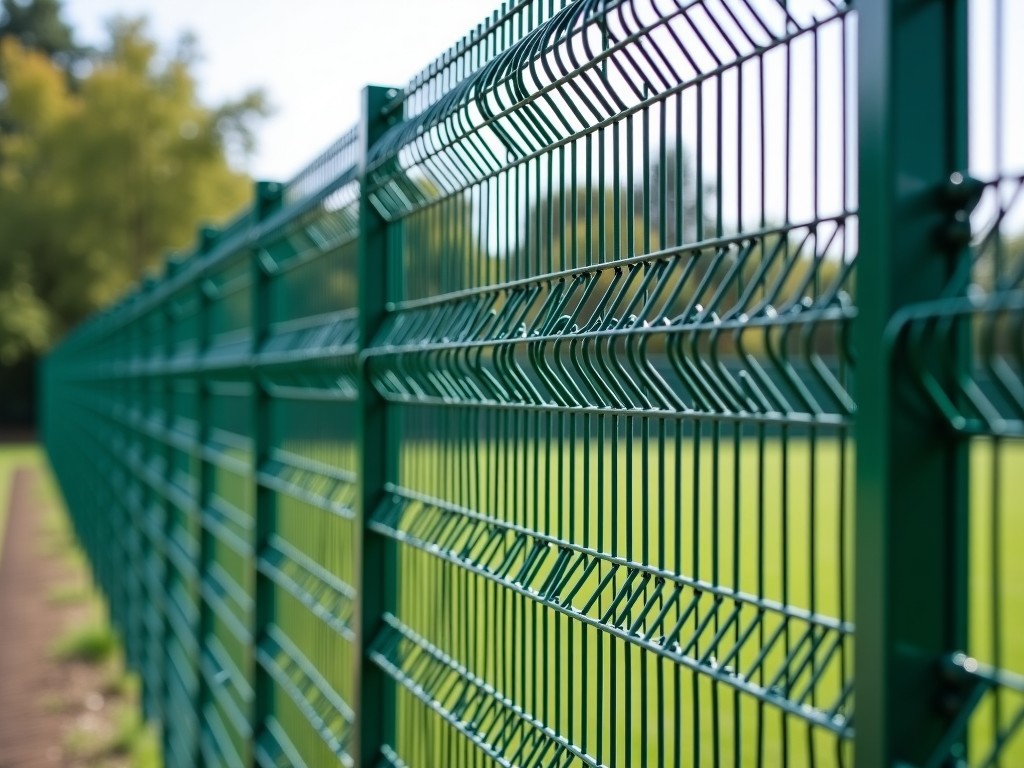
Bulk Wire Mesh Fence Wholesale Supplier
Wire mesh fence supplied in bulk rolls serves as a durable barrier for perimeter security, livestock containment, and site protection. The product is manufactured from low‑carbon steel wire, formed
Bulk Wire Mesh Fence Wholesale Supplier
Overview
Wire mesh fence supplied in bulk rolls serves as a durable barrier for perimeter security, livestock containment, and site protection. The product is manufactured from low‑carbon steel wire, formed into a uniform grid, and coated to resist corrosion. Wholesale distribution focuses on consistent roll dimensions, tensile strength, and coating adhesion to meet large‑scale project specifications.
Material Composition and Specifications
The core wire is typically SAE 1006/1008 low‑carbon steel with a carbon content below 0.10 %, providing a balance of formability and tensile strength. Wire diameters range from 1.2 mm to 4.0 mm, selected based on required load‑bearing capacity. Mesh apertures are defined as the clear opening between adjacent wires, commonly offered in 25 mm, 50 mm, 75 mm, and 100 mm square patterns.
| Parameter | Typical Range | Notes |
|---|---|---|
| Wire Diameter | 1.2 mm – 4.0 mm | Custom sizes available upon request |
| Mesh Aperture | 25 mm – 100 mm square | Other patterns (rectangular, hexagonal) customizable |
| Roll Width | 0.5 m – 3.0 m | Standard widths: 1.0 m, 1.5 m, 2.0 m |
| Roll Length | 10 m – 100 m | Lengths cut to project requirements |
| Coating Type | Galvanized (Zn), PVC‑coated, Powder‑coated | Coating thickness typically 15 µm – 70 µm Zn |
Manufacturing Process
Wire is drawn to the target diameter, then straightened and cut to length. Automated welding machines intersect the wires at each crossover point, forming a solid joint without compromising ductility. After welding, the mesh passes through a cleaning line to remove oxides before entering the coating station, where hot‑dip galvanizing or electrostatic powder application ensures uniform coverage. Final rolling onto cores maintains tension control to prevent deformation.
Dimensional checks are performed inline using laser sensors that verify wire spacing and weld integrity at speeds up to 60 m/min. Any deviation beyond ±0.5 mm triggers an automatic reject, ensuring that only mesh meeting the specified aperture tolerance proceeds to packaging.
Application Considerations
In agricultural settings, a 2 mm wire with 50 mm aperture provides sufficient resistance to animal pressure while allowing visibility and airflow. For high‑security perimeters, increasing wire diameter to 3.5 mm and reducing aperture to 25 mm raises the climb‑resistance rating and enhances impact load capacity. The coating selection influences service life: hot‑dip galvanized finishes typically exceed 20 years in rural environments, whereas PVC coating adds abrasion resistance for industrial facilities.
Construction sites often require rapid deployment; therefore, rolls with integrated edge flaps or pre‑bent corners reduce installation time. The tensile strength of the welded joints, typically exceeding 350 MPa for 2.5 mm wire, ensures the fence retains structural integrity under dynamic loads such as wind or vehicle impact.
Customization Options
- Wire diameter: 1.2 mm – 4.0 mm (increment 0.1 mm)
- Mesh aperture: square, rectangular, hexagonal; custom sizes available
- Coating: hot‑dip galvanized, galvanized + PVC, powder‑coated in RAL colors
- Roll width: 0.5 m – 3.0 mm; custom slit widths
- Roll length: cut to length, standard lengths 10 m, 20 m, 50 m, 100 m
- Edge finish: straight, knuckled, twisted, or reinforced with binding wire
Quality Control and Testing
Each batch undergoes tensile testing on wire samples according to ASTM A370, recording yield and ultimate strength. Coating adhesion is assessed via ASTM D4541 pull‑off tests, ensuring a minimum adhesion value of 4 MPa for galvanized layers. Dimensional uniformity is validated by sampling 10 % of rolls and measuring aperture deviation across the roll length; acceptance criteria limit variation to ±0.5 mm.
Visual inspection identifies weld defects such as under‑fill or excess spatter; any weld failing to meet a 90 % visual acceptance rate triggers a full line stop. All test results are retained in a traceability system linked to the roll’s unique barcode, enabling retrieval of certification data for each shipment.
Packaging and Logistics
Rolls are wrapped in UV‑stabilized polyethylene film to protect against moisture during transit. Core ends are fitted with plastic caps to prevent edge deformation. For containerized shipments, rolls are stacked on pallets with interlocking layers and secured with polyester strapping, achieving a maximum stack height of 2.0 m without compromising roll integrity.
Pallet dimensions conform to ISO 6780 standards, facilitating seamless handling with forklifts and pallet jacks. Each pallet carries a gross weight not exceeding 1,200 kg, complying with typical road‑transport axle load limits. Export documentation includes material safety data sheets (MSDS) for coatings and origin certificates upon request.
Frequently Asked Questions
Can dimensions be customized?
Yes. Wire diameter, mesh aperture, roll width, and length are all adjustable to meet project specifications. Custom tooling may be required for non‑standard apertures, which can affect lead time.
What information is required before quotation?
To generate an accurate quote, provide the desired wire diameter, aperture size, roll dimensions, coating type, quantity, and delivery destination. Any special edge finishes or certifications should also be specified.
How is quality inspected?
Inline laser sensors monitor aperture and weld consistency. End‑of‑line tensile and adhesion tests verify mechanical and protective properties. All results are documented and linked to each roll’s barcode.
Get a Quote
For bulk orders or technical consultation, please reach out to our sales team. Provide your project parameters and we will return a detailed quotation with lead‑time and packaging options.