
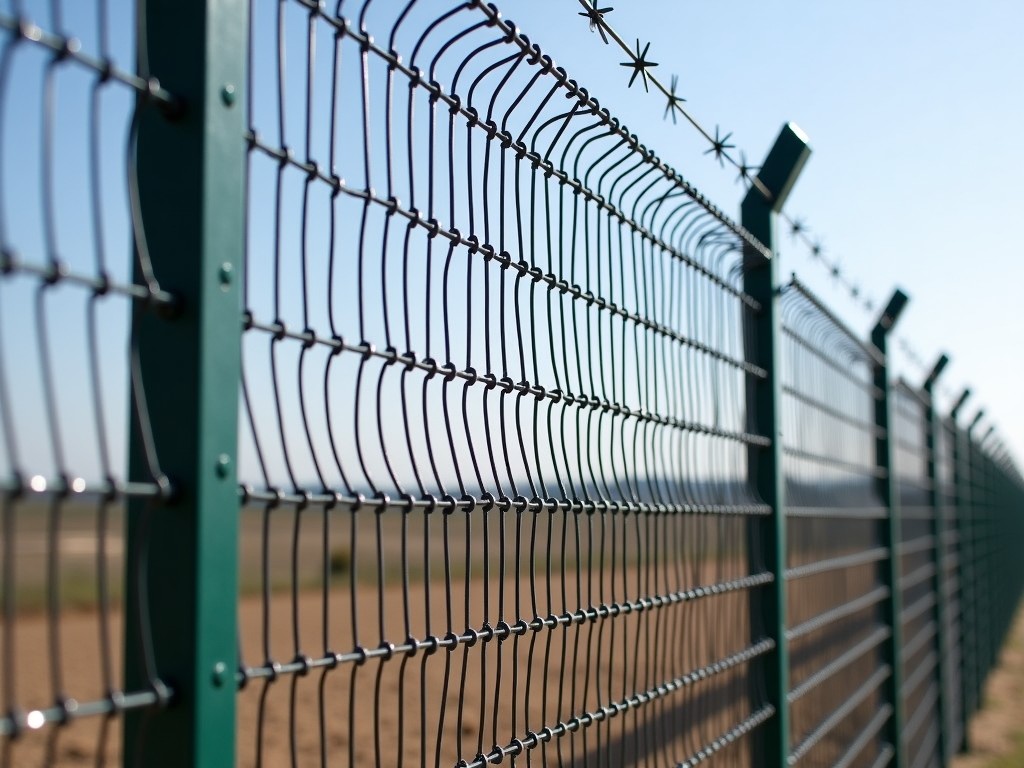
Bulk Razor Wire Mesh Custom Manufacturer
Razor wire mesh is a security barrier formed by intertwining sharp-edged steel blades with a high-tensile wire core, producing a mesh that resists cutting and climbing. Bulk supply allows continuous
Bulk Razor Wire Mesh – Custom Manufacturer
Product Overview
Razor wire mesh is a security barrier formed by intertwining sharp-edged steel blades with a high-tensile wire core, producing a mesh that resists cutting and climbing. Bulk supply allows continuous rolls or panels tailored to perimeter lengths, reducing joints and installation time.
Typical core wire diameters range from 2.0 mm to 3.5 mm, with blade thicknesses of 0.5 mm to 0.8 mm and blade lengths (height) from 15 mm to 30 mm. These dimensions determine the tensile strength and penetration resistance of the mesh.
Material Options
The core wire is usually cold‑drawn galvanized steel (Zn coating 275 g/m²) or stainless steel (AISI 304 or 316) for corrosive environments. Blade material matches the core to avoid galvanic coupling.
- Galvanized steel – suitable for standard outdoor installations, zinc coating provides sacrificial protection.
- Stainless steel 304 – resistant to urban pollution and mild chemical exposure.
- Stainless steel 316 – preferred for marine or industrial chemical atmospheres due to higher molybdenum content.
Customization Parameters
Buyers can specify roll width, mesh opening size, blade spacing, and coating thickness to meet project‑specific security levels and installation constraints.
| Parameter | Typical Range | Notes |
|---|---|---|
| Roll width (mesh height) | 0.8 m – 2.5 m | Custom widths available upon request. |
| Mesh opening (center‑to‑center) | 50 mm – 150 mm | Smaller openings increase blade density. |
| Blade length (height) | 15 mm – 30 mm | Longer blades raise penetration resistance. |
| Core wire diameter | 2.0 mm – 3.5 mm | Affects tensile strength and handling. |
| Coating thickness (galvanized) | 275 g/m² – 550 g/m² | Stainless grades omit coating. |
Applications and Performance Rationale
Razor wire mesh is selected when a physical barrier must deter both manual cutting and climbing attempts. The combination of tensile core and protruding blades creates a load‑path that transfers force to the blades, causing them to snag and potentially injure an intruder.
Typical installations include perimeter fencing for power substations, water treatment plants, correctional facilities, and high‑value storage yards. In these settings, the mesh reduces the likelihood of successful breach by increasing the time and effort required to penetrate the barrier.
Environmental factors such as UV exposure, salinity, and industrial pollutants dictate material choice; galvanized suffices for inland temperate climates, while stainless 316 is advised for coastal or chemical‑plant perimeters.
Quality Control and Testing
Each production lot undergoes dimensional verification of wire diameter, blade length, and mesh pitch using calibrated calipers and optical comparators. Tensile tests on core wire confirm compliance with specified minimum yield strength (typically ≥ 350 MPa for galvanized, ≥ 500 MPa for stainless 304).
Coating thickness is measured by magnetic induction or X‑ray fluorescence to ensure zinc mass per area meets the ordered grade. Visual inspection checks for blade uniformity, absence of burrs, and proper interlocking of the mesh.
Final product is subjected to a simulated climb test where a weighted load is applied to the mesh surface; resistance is recorded as the load at which blade deformation or wire rupture occurs.
Packaging and Logistics
Bulk rolls are wound on sturdy cardboard or steel cores, wrapped in UV‑stabilized polyethylene film, and secured with steel strapping. Palletized units are fitted with corner protectors and stretch‑wrapped for container stability.
Standard pallet dimensions are 1.1 m × 1.1 m, with a maximum stack height of 1.8 m to comply with container loading regulations. Export shipments include fumigation‑certified wood pallets where required by destination country.
Frequently Asked Questions
Yes. Roll width, mesh opening, blade length, and core wire diameter are all adjustable to match project specifications.
Project length or area, desired material (galvanized or stainless grade), required tensile strength, and any special coating or packaging needs.
Dimensional checks, tensile testing, coating thickness measurement, and visual inspection are performed on each lot.
Standard polyethylene‑wrapped rolls on cardboard or steel cores, palletized with corner protection; custom crating or container‑load configurations upon request.
Lead time varies with order size and material availability, generally 3–5 weeks for standard galvanized mesh and 4–6 weeks for stainless grades.
Contact for Custom Quote
To discuss your specific perimeter security requirements, provide the project dimensions, material preference, and any performance criteria. Our engineering team will return a detailed quotation including lead time, packaging options, and compliance documentation.
Request Quote