
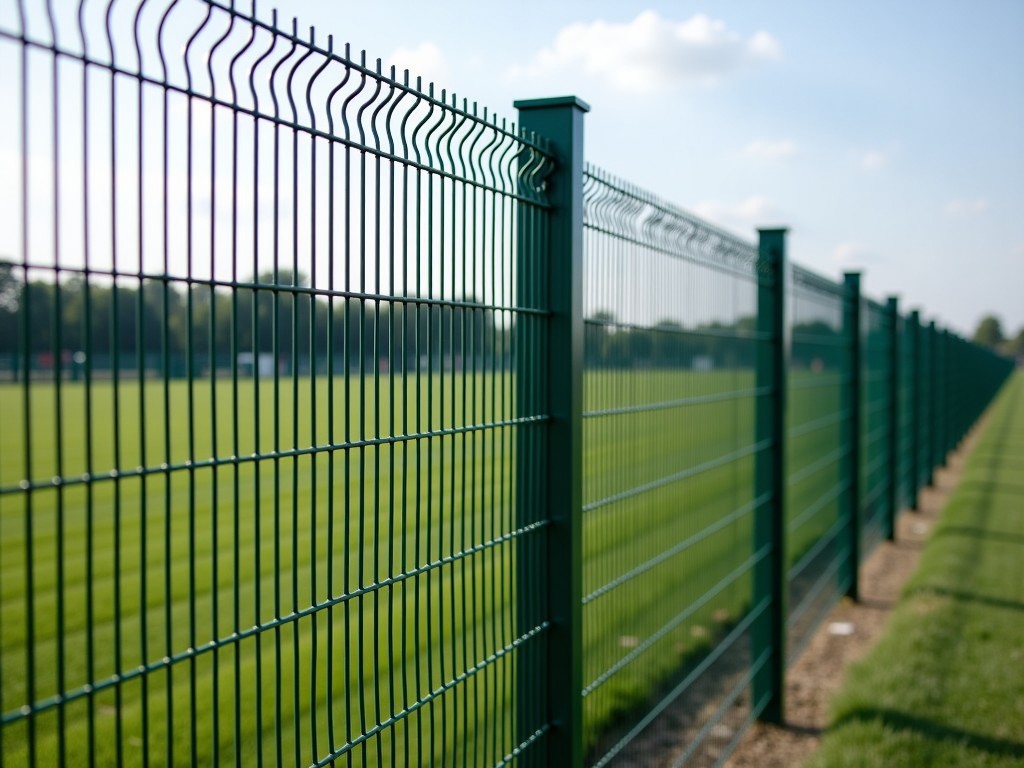
Bulk Coated Welded Wire Fence Company
This page describes the engineering characteristics of welded wire fence supplied in bulk rolls, focusing on wire geometry, weld integrity, coating systems, and dimensional tolerances that affect
Bulk Coated Welded Wire Fence – Technical Overview
This page describes the engineering characteristics of welded wire fence supplied in bulk rolls, focusing on wire geometry, weld integrity, coating systems, and dimensional tolerances that affect long‑term performance in agricultural, security, and industrial applications.
Product Construction
The fence consists of low‑carbon steel wires arranged in a rectangular grid, welded at each intersection to form a uniform mesh. Wire diameters typically range from 2.5 mm to 5.0 mm, providing tensile strengths between 350 MPa and 550 MPa depending on grade.
Mesh openings are defined by the nominal spacing between wires; common configurations include 50 mm × 50 mm, 75 mm × 75 mm, and 100 mm × 150 mm. The weld shear strength is verified through pull‑off testing, with acceptable values exceeding 1.5 kN per joint for the specified wire sizes.
- Wire diameter options: 2.5 mm, 3.0 mm, 3.5 mm, 4.0 mm, 4.5 mm, 5.0 mm (custom sizes available upon request)
- Mesh opening range: 30 mm × 30 mm to 150 mm × 200 mm, adjustable in 5 mm increments
- Roll lengths: standard 25 m, 50 m, 100 m; custom lengths up to 200 m based on handling equipment
Coating Types and Performance
Protective coatings are applied after welding to prevent corrosion and extend service life. The coating thickness, adhesion, and UV stability directly influence maintenance intervals and expected lifespan in various environments.
| Coating System | Typical Thickness | Salt Spray Resistance (hours) | UV Stability (years) | Temperature Range (°C) |
|---|---|---|---|---|
| Hot‑dip Galvanized (Zn) | 50 µm – 100 µm | 500 – 1200 | >10 | ‑40 to +120 |
| Electro‑galvanized (Zn) | 10 µm – 25 µm | 100 – 300 | 5 – 8 | ‑30 to +100 |
| PVC (polyvinyl chloride) | 0.3 mm – 0.6 mm | 800 – 1500 | 7 – 12 | ‑20 to +70 |
| PE (polyethylene) | 0.3 mm – 0.6 mm | 600 – 1300 | 8 – 15 | ‑30 to +80 |
| Powder Coating (epoxy/polyester) | 0.06 mm – 0.12 mm | 400 – 900 | 5 – 10 | ‑25 to +90 |
Dimensional Specifications
| Property | Typical Range | Unit |
|---|---|---|
| Wire Diameter | 2.5 – 5.0 | mm |
| Mesh Opening (Width) | 30 – 150 | mm |
| Mesh Opening (Height) | 30 – 200 | mm |
| Roll Width | 0.5 – 2.5 | m |
| Roll Length | 25 – 200 | m |
| Weight per Meter (approx.) | 0.8 – 4.5 | kg/m |
Applications
The mechanical and corrosion properties of coated welded wire fence make it suitable for environments where durability, containment, and visibility are required. Selection depends on load expectations, exposure conditions, and service life targets.
- Agricultural livestock enclosures – high tensile wire resists impact from animals; PVC or PE coatings prevent rust in moist soil conditions.
- Security perimeters for warehouses and factories – galvanized or powder‑coated finishes provide long‑term barrier integrity with minimal maintenance.
- Temporary construction site fencing – lightweight rolls with knuckle edges allow rapid installation and removal while meeting safety standards.
- Wildlife management barriers – small mesh openings (30 mm × 30 mm) prevent ingress of rodents; coating thickness selected for UV exposure in open fields.
- Industrial partitioning and machine guarding – powder‑coated surfaces offer chemical resistance and a clean appearance for interior environments.
Quality Control
Each production lot undergoes dimensional verification, weld strength assessment, and coating adhesion testing to confirm conformance with project specifications. Non‑destructive methods are preferred to preserve the integrity of the bulk roll.
- Wire diameter measured with laser micrometers; tolerance ±0.05 mm.
- Mesh opening checked using calibrated gauges; deviation limited to ±2 mm.
- Weld shear strength tested per ISO 9018; acceptance criterion >1.5 kN per joint.
- Coating adhesion evaluated by cross‑cut tape test (ASTM D3359); rating 4B or better required.
- Visual inspection for surface defects, missed welds, and coating uniformity performed on 100 % of roll length at 5 m intervals.
Customization Options
Manufacturers adjust wire gauge, mesh geometry, coating type, and roll dimensions to match specific project constraints such as load limits, corrosion exposure, and handling equipment.
- Wire diameter: 2.0 mm to 6.0 mm (intermediate sizes available)
- Mesh opening: custom rectangular or square patterns, minimum 20 mm
- Coating: hot‑dip galvanized, electro‑galvanized, PVC, PE, powder coating; color matching to RAL or Pantone on request
- Roll width: 0.3 m to 3.0 m; edge finishes: knuckle, twist, or barbed
- Length: standard 25 m–200 m; spliceless continuous lengths up to 500 m for special logistics
Packaging and Handling
Bulk rolls are protected during transit and storage to prevent mechanical damage and coating degradation. Packaging methods are selected based on roll weight, length, and destination climate.
- Inner layer: UV‑stabilized stretch film to guard against moisture and abrasion
- Outer layer: corrugated cardboard corners and edge protectors for impact resistance
- Palletization: wooden or plastic pallets with strapping; typical load capacity 2 t per pallet
- Labeling: includes product code, wire diameter, mesh size, coating type, length, weight, and batch number for traceability
Frequently Asked Questions
-
Can dimensions be customized?
Yes – wire diameter, mesh opening, roll width, and length can be adjusted to meet project‑specific requirements. Custom tooling may apply for non‑standard meshes. -
What information is required before quotation?
To generate an accurate quote we need: required wire gauge, mesh dimensions, coating type, roll length, quantity, and any special packaging or testing requests. -
Which materials are available for the core wire?
Low‑carbon steel grades such as SAE 1008/1010 are standard; higher tensile alloys can be supplied upon request for increased load capacity. -
How is quality inspected?
Inspection includes dimensional verification, weld shear testing, coating adhesion (cross‑cut), and visual examination at defined intervals along each roll. -
What packaging methods are available?
Standard packaging uses UV stretch film plus corner protectors on pallets; moisture‑barrier bags or wooden crates are options for harsh environments. -
How are export shipments protected?
Rolls are sealed in shrink‑wrap, placed on fumigated pallets, and secured with steel strapping; additional desiccant packets can be included for humid climates. -
What is the typical production lead time?
Lead time varies with coating and customization; standard galvanized rolls ship in 2–3 weeks, while PVC or powder‑coated orders require 4–6 weeks. Exact timing is confirmed at quote. -
How are samples arranged?
Sample lengths (typically 1 m to 2 m) can be sent via courier; sample preparation and shipping costs are credited against a subsequent order.
Contact for Technical Inquiry
For detailed data sheets, coating performance certificates, or to discuss project‑specific requirements, reach out to our engineering team.