
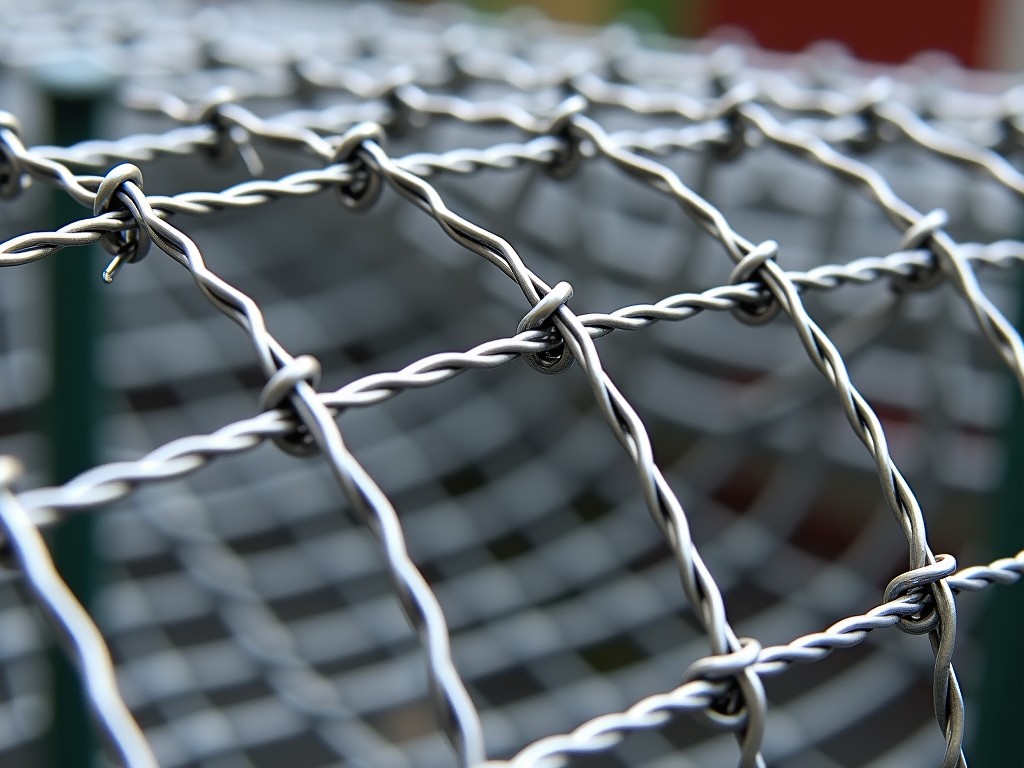
B2B High Quality Razor Wire Mesh Factory
Razor wire mesh serves as a perimeter security solution where high tensile strength and corrosion resistance are required. Manufacturers produce it by helically wrapping cold‑drawn steel wire around
B2B High-Quality Razor Wire Mesh Factory
Razor wire mesh serves as a perimeter security solution where high tensile strength and corrosion resistance are required.
Manufacturers produce it by helically wrapping cold‑drawn steel wire around a central core wire, forming a series of sharp barbs that deter climbing.
Industrial buyers evaluate the product based on wire gauge, coating type, aperture size, and roll length to match site‑specific threat levels.
Technical Specifications
Key parameters include wire diameter, core wire diameter, barb length, spacing, and overall roll weight.
Typical wire diameters range from 2.0 mm to 3.5 mm, while core wires are often 1.8 mm to 2.8 mm, giving a finished mesh thickness between 4.0 mm and 6.5 mm.
Material Options
The base steel is usually low‑carbon cold‑drawn wire, selected for its uniform tensile properties.
To protect against environmental attack, manufacturers apply either hot‑dip galvanizing, zinc‑aluminum alloy coating, or PVC over‑coat.
Coating thickness is measured in grams per square meter (g/m²) and directly influences expected service life in coastal or industrial atmospheres.
| Coating Type | Typical Coating Weight (g/m²) | Expected Service Life (years) | Typical Applications |
|---|---|---|---|
| Hot-dip Galvanizing | 60‑120 | 10‑15 | General perimeter fencing |
| Zinc‑Aluminum (Galvalume) | 80‑150 | 15‑25 | Coastal/marine environments |
| PVC Over‑coat | 0.2‑0.4 mm thickness | 12‑18 | Chemical plants, wastewater facilities |
Applications
Facilities that require delayed intrusion detection, such as power substations, water treatment plants, and correctional complexes, benefit from the psychological and physical barrier razor wire mesh provides.
The sharp barbs increase the time needed for an intruder to breach a fence, allowing security personnel to respond.
Because the mesh can be tensioned between posts or attached to existing chain‑link fences, it integrates with standard perimeter systems without major structural changes.
- Power generation substations
- Water treatment facilities
- Transportation hubs
- Correctional institutions
- Military bases
- Industrial storage yards
Customization Options
Roll length, barb spacing, and coil diameter can be adjusted to match site‑specific fence height and tension requirements.
Clients often specify wire gauge to achieve a target breaking strength, measured in kilonewtons (kN), while maintaining manageable handling weight.
End finishes such as looped ends, welded caps, or plastic tips are available to facilitate installation and reduce handling injuries.
Quality Control Process
Each production lot undergoes dimensional verification using calibrated micrometers and laser scanners to confirm wire diameter and pitch.
Coating adhesion is tested by cross‑cut tape per ASTM D3359, and corrosion resistance is assessed via salt‑spray exposure per ASTM B117 for a minimum of 500 hours.
Final inspection includes tensile strength testing of random samples, with acceptance criteria typically set at 95 % of the specified minimum breaking load.
Packaging and Shipping
Finished rolls are wound onto cardboard or plastic cores, then wrapped in stretch film to protect the coating during transit.
For export shipments, rolls are placed in wooden pallets with corner protectors and secured with polyester strapping to prevent shifting.
Each pallet carries a label indicating coil dimensions, weight, coating type, and batch number for traceability.
Frequently Asked Questions
Can dimensions be customized?
Yes, roll length, barb spacing, coil diameter, and wire gauge can be tailored to project specifications.
What information is required before quotation?
We need site dimensions, desired fence height, threat level, coating preference, and any required end finishes.
What materials are available?
Base wire is low‑carbon cold‑drawn steel; coatings include hot‑dip galvanizing, zinc‑aluminum alloy, and PVC over‑coat.
How is quality inspected?
Dimensional checks, coating adhesion tests, salt‑spray corrosion testing, and tensile strength sampling are performed on each lot.
What packaging methods are available?
Rolls are core‑wrapped, stretch‑filmed, palletized with corner protectors, and secured with polyester strapping for export.
Call to Action
To discuss your specific perimeter security requirements, provide the site dimensions, threat level, and preferred coating type.
Request a quotation to receive a detailed lead time and packaging proposal within one business day.