
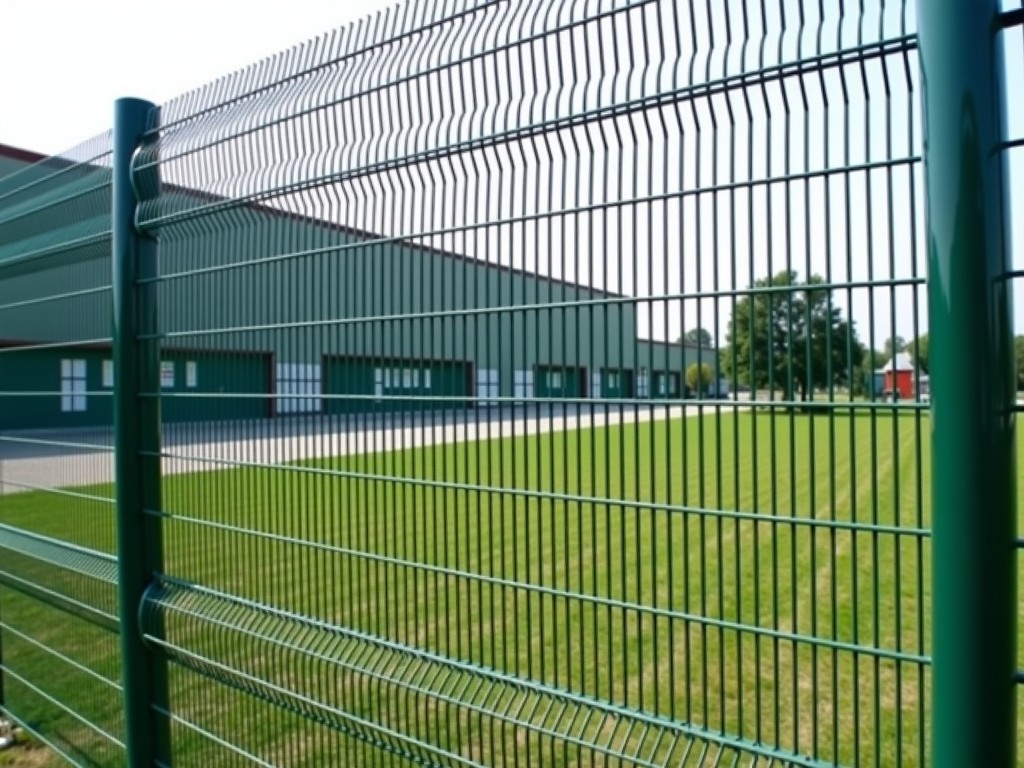
B2B High Quality Metal Wire Fence Supplier
Industrial perimeter solutions require fences that maintain structural integrity under dynamic loads while resisting corrosion in varied environments. This page details the engineering
B2B Metal Wire Fence Supplier – Technical Overview
Industrial perimeter solutions require fences that maintain structural integrity under dynamic loads while resisting corrosion in varied environments. This page details the engineering specifications, manufacturing controls, and selection criteria for metal wire fences supplied to B2B clients.
Material Composition and Mechanical Properties
Fence wires are produced from low‑carbon steel rods with a carbon content of 0.08‑0.12 %, providing a yield strength of approximately 350 MPa and a tensile strength ranging from 500 MPa to 620 MPa depending on diameter. Standard galvanizing follows ASTM A123 with a zinc coating mass of 275 g/m², delivering a corrosion resistance of up to 15 years in C3 atmospheres. For aggressive chemical exposure, a PVC over‑coat of 0.4 mm‑0.6 mm thickness is applied, raising the chemical resistance rating to ISO 12944‑5 C5‑M.
Wire diameters are offered in 2.0 mm, 2.5 mm, 3.0 mm, 3.5 mm, 4.0 mm, and 5.0 mm increments, allowing designers to match aperture size and panel stiffness to load requirements. The relationship between diameter and flexural rigidity follows the equation EI ∝ d⁴, meaning a 3.0 mm wire provides roughly 2.3 times the bending stiffness of a 2.5 mm wire.
Manufacturing Process and Tolerances
Wire drawing is performed on inline dies with a tolerance of ±0.02 mm on diameter, ensuring consistent cross‑sectional area across batches. After drawing, wires undergo a continuous hot‑dip galvanizing line where the bath temperature is maintained at 450 °C ± 5 °C and the immersion time is calibrated to achieve the target coating weight.
Welded mesh panels are formed using resistance spot welding with a weld penetration depth of 0.6 mm ± 0.1 mm, producing shear strengths exceeding 80 % of the base wire tensile strength. Panel squareness is held to within 2 mm over a 2 m length, verified by laser scanning before packaging.
Standard Configurations and Customization Options
- Aperture sizes: 50 × 50 mm, 75 × 75 mm, 100 × 100 mm, 150 × 150 mm, with custom openings available upon request.
- Panel heights: 1.0 m, 1.2 m, 1.5 m, 1.8 m, 2.0 m, and 2.4 m; lengths up to 6.0 m per panel.
- Edge finishes: folded selvage, welded edge, or PVC‑capped edge for safety.
- Post options: C‑channel, square tube, or round pipe with pre‑drilled holes for rapid installation.
Customization extends to coating combinations—for example, a galvanized core with a polyester powder topcoat of 80 µm thickness for UV stability—or the integration of anti‑climb barbs with a diameter of 4 mm and a spacing of 100 mm.
Typical Applications in Industrial Environments
In logistics centers, the fence provides a barrier that withstands forklift impact loads of up to 5 kN without permanent deformation, thanks to the high tensile strength and ductility of the galvanized wire.
For wastewater treatment plants, the PVC‑coated variant resists sulfide‑induced corrosion, maintaining structural integrity in environments with pH levels as low as 4 and chloride concentrations up to 20 g/L.
In renewable energy farms, the fence’s low magnetic permeability (µr ≈ 1.0) ensures minimal interference with nearby photovoltaic inverters and monitoring equipment.
Quality Assurance and Testing Protocols
Each production lot undergoes tensile testing per ISO 6892‑1 on five random wire samples, with acceptance criteria set at a minimum tensile strength of 500 MPa and elongation at break ≥ 15 %.
Coating thickness is verified by magnetic induction gauges, targeting a zinc mass of 275 g/m² ± 10 % and a PVC layer of 0.5 mm ± 0.05 mm. Adhesion of the PVC over‑coat is assessed via cross‑hatch tape testing, requiring a rating of 5B per ASTM D3359.
Panel flatness is checked using a straightedge and feeler gauge, allowing a maximum deviation of 3 mm over a 1 m span. All test results are recorded in a traceable batch report supplied with each shipment.
Technical Data
| Parameter | Typical Value | Notes |
|---|---|---|
| Wire Diameter | 2.0 mm – 5.0 mm | Increment steps of 0.5 mm |
| Tensile Strength | 500 MPa – 620 MPa | Dependent on diameter and cold work |
| Yield Strength | ≈ 350 MPa | Low‑carbon steel base |
| Zinc Coating Mass | 275 g/m² | ASTM A123, ±10 % tolerance |
| PVC Over‑coat Thickness | 0.4 mm – 0.6 mm | Optional, chemical resistant |
| Aperture Size | 50 × 50 mm – 150 × 150 mm | Custom sizes available |
| Panel Height | 1.0 m – 2.4 m | Standard lengths up to 6.0 m |
| Wind Load Resistance | Up to 2.5 kN/m² | Based on 2.0 mm wire, 100 mm aperture |
Ordering Information and Lead Times
Quotations require the following technical details: wire diameter, aperture dimensions, panel height and length, coating type (galvanized, PVC‑coated, or duplex), edge finish, and any post or accessories. Providing a simple sketch or CAD file accelerates the engineering review.
Standard lead time for stocked specifications (2.5 mm wire, 100 mm aperture, 1.8 m height, galvanized) is 10‑12 working days from receipt of a signed purchase order. Custom coatings or non‑standard apertures extend the schedule to 18‑22 working days, pending material procurement and tooling validation.
Shipments are packed on steel pallets with corner protectors and stretch‑film wrapping. Each pallet includes a packing list, material test certificates, and installation guidelines. Export containers are fitted with desiccant bags to maintain relative humidity below 50 % during transit.
Request a Technical Consultation
To discuss your project’s specific load, environmental, and dimensional requirements, please use the contact form below. Our engineering team will respond with a detailed feasibility report, including finite‑element analysis of panel deflection under anticipated loads.
Submit Inquiry