
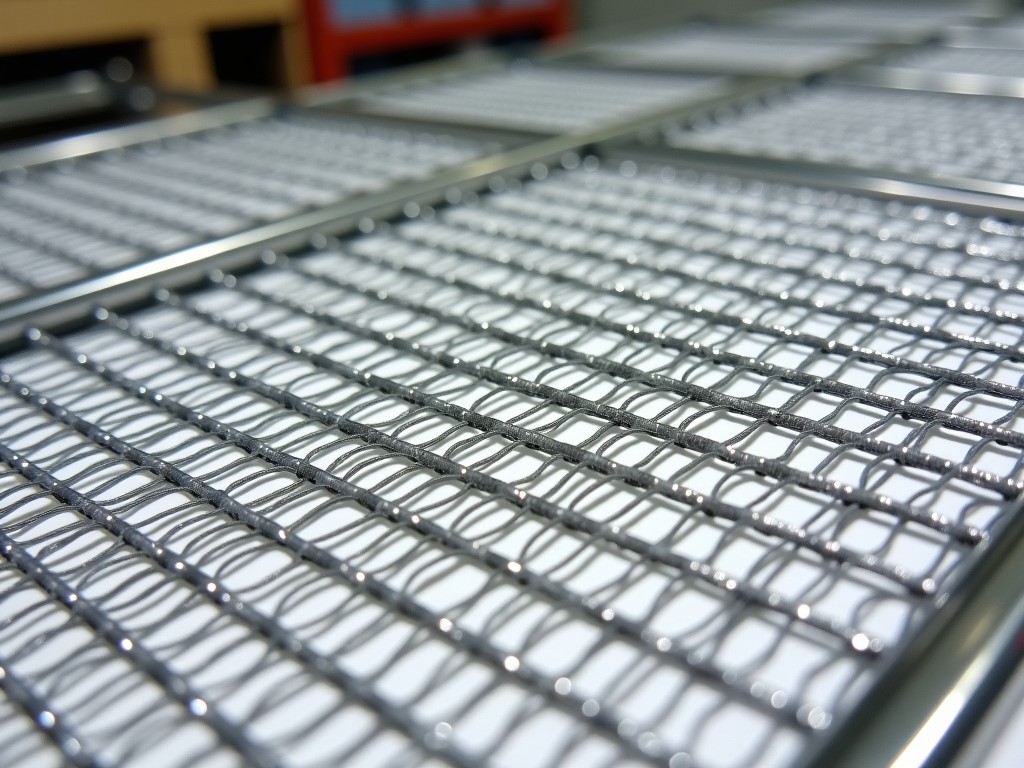
B2B Durable Wire Net Top Factory
This component forms the upper mesh layer of wire‑net assemblies used in filtration, separation, and containment systems across manufacturing, mining, and agro‑processing plants. Its geometry and
Durable Wire Net Top for B2B Industrial Applications
This component forms the upper mesh layer of wire‑net assemblies used in filtration, separation, and containment systems across manufacturing, mining, and agro‑processing plants. Its geometry and material selection directly influence flow resistance, load bearing capacity, and service life under continuous operation.
Overview of Wire Net Top Construction
A wire net top consists of intersecting wires welded or woven at precise junctions to create a uniform aperture pattern. The topology determines open area percentage, which governs how much fluid or particulate can pass while maintaining structural integrity.
Typical aperture sizes range from 0.5 mm to 5 mm, with wire diameters between 0.8 mm and 3 mm selected according to the expected mechanical load and abrasive environment.
Technical Specifications
| Parameter | Typical Range | Notes |
|---|---|---|
| Aperture size | 0.5 mm – 5 mm | Customizable per process flow |
| Wire diameter | 0.8 mm – 3 mm | Affects tensile strength |
| Open area % | 30 % – 70 % | Determined by wire spacing |
| Tensile strength (wire) | 300 MPa – 600 MPa | Dependent on material grade |
| Operating temperature | -40 °C to +250 °C | With suitable alloy |
Material Options and Their Implications
The wire net top can be fabricated from stainless steel grades (304, 316L), carbon steel with galvanizing, or specialty alloys such as Inconel for high‑temperature corrosion resistance.
- Stainless steel 304 – good general corrosion resistance, suitable for food‑grade and water treatment.
- Stainless steel 316L – enhanced resistance to chlorides, used in marine and chemical processing.
- Galvanized carbon steel – cost‑effective for dry, non‑abrasive environments; zinc coating provides sacrificial protection.
- Inconel 600 – retains strength above 800 °C, ideal for furnace exhaust filters.
Selection hinges on the chemical composition of the process fluid, temperature cycling, and expected wear from particulate impingement.
Typical Industrial Applications
In mining slurry dewatering, the wire net top retains coarse particles while allowing clarified liquid to pass, reducing load on downstream filters.
Food‑grade stainless steel versions are employed in grain screening where hygiene standards demand non‑toxic, easy‑to‑clean surfaces that resist bacterial growth.
Chemical plants use corrosion‑resistant alloys to separate catalysts from reaction mixtures, where any degradation could contaminate product streams.
Power generation facilities install these tops in cooling‑tower water filters to protect pumps from debris without imposing excessive pressure drop.
Manufacturing Considerations
Production begins with drawing wire to the specified diameter, followed by precision weaving or welding to achieve the target aperture layout.
Automated CNC welding ensures consistent joint strength, reducing the risk of premature failure at high‑stress intersections.
Post‑forming, the net undergoes stress‑relief annealing (for stainless grades) to minimize residual stresses that could cause distortion under load.
Dimensional inspection is performed using optical comparators and coordinate measuring machines to verify aperture uniformity within ±0.05 mm tolerance.
Quality Assurance Philosophy
Each batch is subjected to tensile testing on representative wire samples to confirm that the material meets the certified grade specifications.
Open‑area verification is conducted via image analysis software, ensuring that the actual porosity aligns with design values critical for flow calculations.
Visual inspection under magnification identifies any welding defects, such as porosity or incomplete fusion, which could act as crack initiation sites.
Final products are packaged with corrosion‑inhibiting interleaving film and placed in wooden crates designed to prevent deformation during transit.
Customization Options
Beyond standard aperture and wire diameter, customers can request edge treatments such as folded flanges for easier mounting or welded frames for rigid panels.
- Custom panel dimensions up to 2 m × 1 m, with tolerances ±2 mm.
- Surface finishes including passivation, electropolishing, or PVC coating for added chemical barrier.
- Integration of magnetic strips or RFID tags for traceability in automated lines.
Engineering support is available to simulate pressure drop and load distribution using finite‑element analysis before tooling is committed.
Frequently Asked Questions
Can the aperture size be changed after production?
Aperture size is fixed during weaving/welding; post‑production alteration would require re‑weaving or inserting inserts, which is not practical.
What information is needed for a quotation?
Required data include desired aperture, wire diameter, material grade, panel dimensions, edge treatment, and any applicable standards (e.g., ASTM, ISO).
How is quality inspected before shipment?
Each panel undergoes dimensional checks, tensile spot tests, and visual inspection per internal QC‑01 protocol; test certificates are provided on request.
What packaging methods protect the net during transport?
Panels are interleaved with anti‑corrosion film, stacked flat, and secured in wooden crates with foam edge guards to prevent bending.
What is the typical lead time for a custom order?
Lead times range from 3 to 6 weeks depending on material availability and complexity of edge treatments.
Request a Technical Quote
To receive a detailed quotation and discuss application‑specific requirements, please provide your project specifications.
Contact Our Engineering Team