
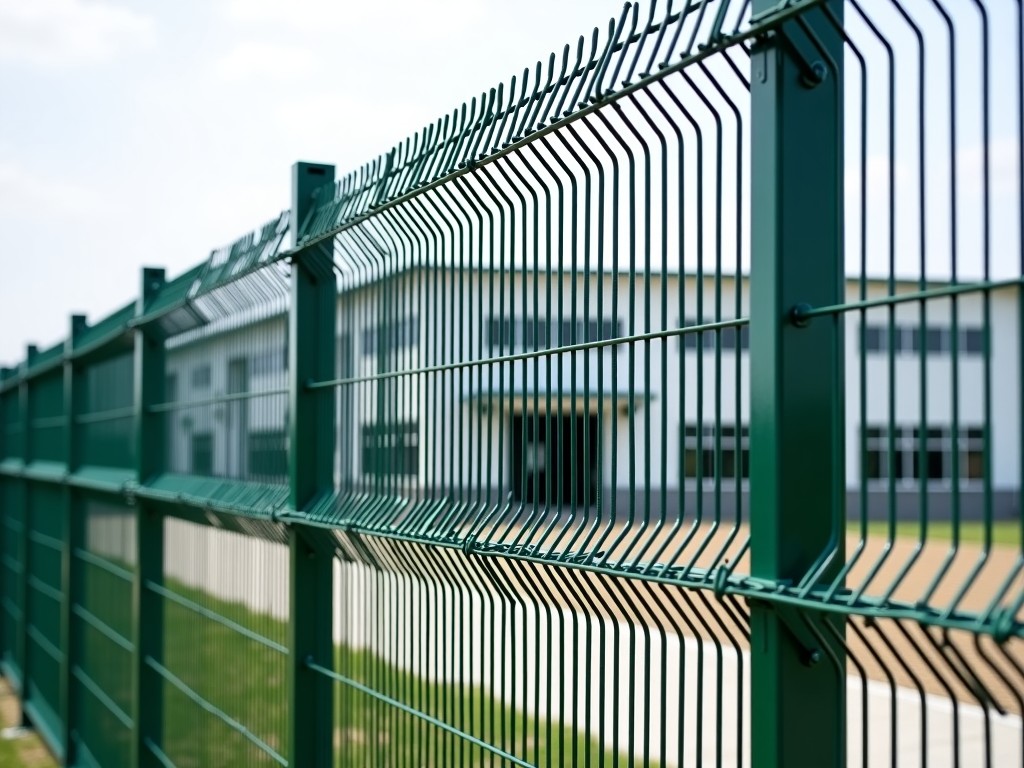
B2B Durable Metal Wire Fence Factory
Industrial procurement often requires perimeter solutions that combine mechanical strength with long‑term corrosion resistance. This section explains how material choice, wire geometry, and
Durable Metal Wire Fence for B2B Applications
Industrial procurement often requires perimeter solutions that combine mechanical strength with long‑term corrosion resistance. This section explains how material choice, wire geometry, and protective treatments determine the fence’s performance in demanding environments.
Material Selection and Structural Design
The fence is typically fabricated from low‑carbon steel wire whose diameter ranges from 2.0 mm to 4.0 mm, providing a tensile capacity between 350 MPa and 450 MPa depending on the grade selected. Wire is drawn to a uniform tolerance of ±0.05 mm to ensure consistent mesh opening dimensions.
After drawing, the wire undergoes a hot‑dip galvanizing process that deposits a zinc coating of 55 µm to 85 µm, meeting ISO 1461 standards for corrosion protection. The welded joints are formed using resistance spot welding, producing a shear strength of at least 2.5 kN per weld under static load.
Customization Options
Buyers can specify mesh aperture sizes from 25 mm × 25 mm up to 100 mm × 100 mm, allowing adaptation to security, animal containment, or debris filtration needs. Panel height is adjustable in 150 mm increments, with standard offerings ranging from 900 mm to 2400 mm.
Post configurations include square steel tubes (50 mm × 50 mm × 2.0 mm) or round posts (Ø60 mm × 2.5 mm), both available with pre‑drilled holes for rapid assembly. Optional top rails or tension wires can be added to increase lateral stability for spans exceeding 3 m.
Typical Industrial Applications
In logistics centers, the fence provides a clear visual barrier while allowing airflow and light penetration, which reduces humidity buildup inside storage zones. The open mesh design also facilitates easy inspection of stored goods without compromising perimeter integrity.
Agricultural facilities use the same product to create livestock enclosures where animal safety depends on smooth wire edges and adequate spacing to prevent hoof entanglement. The galvanized coating resists degradation from ammonia‑rich environments commonly found in poultry houses.
Quality Assurance and Testing
Each production lot undergoes tensile testing on a sample of welded joints to verify that the average shear strength exceeds 2.2 kN, with a maximum allowable deviation of 10 %. Coating thickness is measured using a magnetic induction gauge at five random points per panel, ensuring uniformity within ±5 µm.
Dimensional inspection includes verification of mesh opening width and length using calibrated calipers, with acceptance criteria set at ±2 mm of the specified aperture. Visual inspection checks for weld spatter, coating defects, and wire deformation before packaging.
Technical Specifications
| Parameter | Typical Value | Notes / Customization |
|---|---|---|
| Wire Diameter | 2.0 mm – 4.0 mm | Selected based on load requirements |
| Tensile Strength (Wire) | 350 MPa – 450 MPa | Varies with steel grade |
| Coating Type | Hot‑dip Galvanized (Zn) | Thickness 55 µm – 85 µm (ISO 1461) |
| Mesh Aperture | 25 mm × 25 mm – 100 mm × 100 mm | Customizable per project |
| Panel Height | 900 mm – 2400 mm | Increment steps of 150 mm |
| Post Spacing (Max) | 3.0 m | With intermediate tension wires |
Installation Guidance
Posts are set in concrete footings with a minimum embedment depth of 600 mm for soils with bearing capacity above 100 kPa. After aligning the posts, fence panels are attached using U‑bolts or brackets that allow for vertical adjustment of up to 25 mm to accommodate ground slope.
Tensioning is achieved by tightening the top rail or a dedicated strain wire to a torque of 15 Nm, which limits deflection under wind loads to less than 15 mm over a 3 m span. All fasteners are supplied with zinc‑plated finish to match the fence’s corrosion protection level.
Frequently Asked Questions
- Can dimensions be customized? Yes, wire diameter, mesh aperture, panel height, and post type are all adjustable according to project specifications.
- What information is required before quotation? Please provide required height, length, mesh size, wire gauge, coating preference, and any special post or accessory needs.
- How is quality inspected? Each lot undergoes tensile, coating thickness, and dimensional checks as described in the quality assurance section.
- What packaging methods are available? Panels are bundled in groups of five, wrapped in polyethylene film, and placed on pallets with corner protectors for safe transport.
- What is the typical production lead time? Standard orders ship within 15‑20 working days after receipt of approved drawings; lead times vary for custom coatings or non‑standard post lengths.
Request a Quote or Sample
To begin the evaluation process, share your project details via the contact form and our technical team will return a detailed quotation, including lead time, packaging options, and any required compliance documentation. Request a Quote