
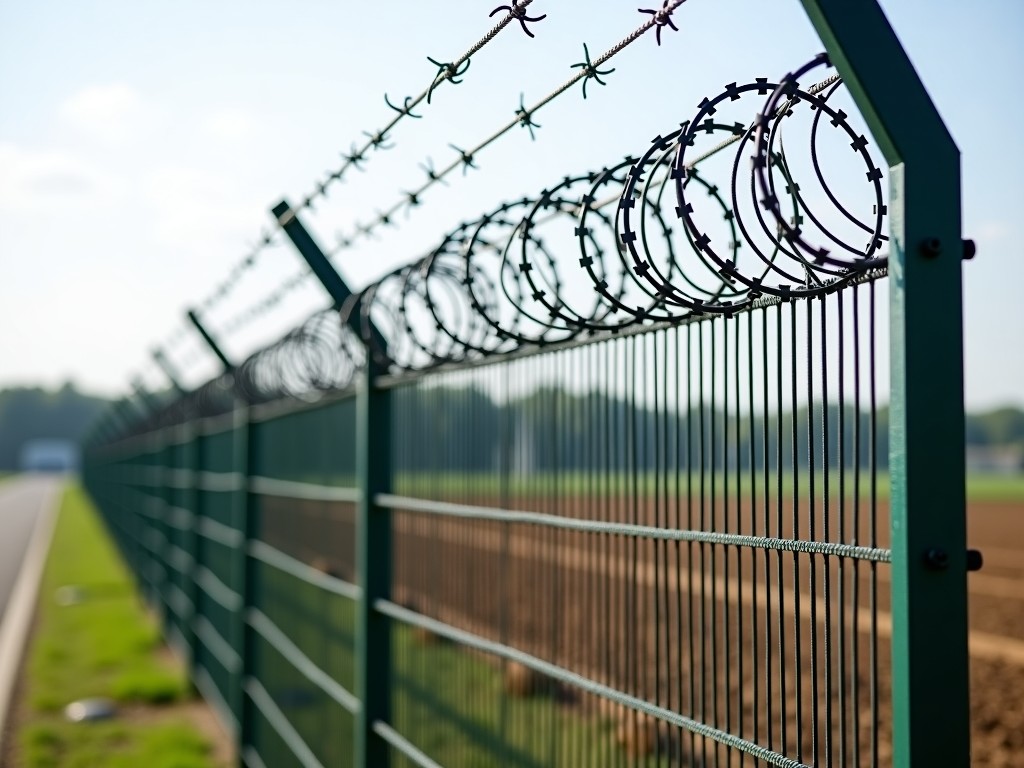
Wholesale Galvanized Steel Barbed Wire Fence For Sale
Galvanized steel barbed wire fence consists of high‑tensile steel strands coated with a protective zinc layer, formed into a helical pattern with uniformly spaced barbs. The zinc coating is applied
Wholesale Galvanized Steel Barbed Wire Fence
Product Overview
Galvanized steel barbed wire fence consists of high‑tensile steel strands coated with a protective zinc layer, formed into a helical pattern with uniformly spaced barbs. The zinc coating is applied by hot‑dip process, providing a metallurgical bond that resists rust and mechanical damage in outdoor environments.
Typical wire diameters range from 12.5 to 9.0 AWG (2.0 mm to 3.0 mm), delivering a balance between flexibility and impact resistance. The barbs are formed by twisting two wire strands around a central core, creating sharp protrusions that deter animal and human intrusion.
Technical Specifications
| Parameter | Typical Value | Unit | Notes |
|---|---|---|---|
| Wire Diameter | 12.5 – 9.0 | AWG | Custom sizes available on request |
| Zinc Coating Weight | 60 – 120 | g/m² (both sides) | Hot‑dip galvanized per ASTM A123 |
| Barb Spacing | 75 – 150 | mm | Adjustable to suit security level |
| Tensile Strength | 550 – 650 | MPa | Minimum yield strength |
| Roll Length | 50 – 200 | m per roll | Standard lengths; custom lengths possible |
| Roll Weight | 15 – 45 | kg | Depends on diameter and length |
Material & Coating Details
The steel core is produced from low‑carbon, high‑strength wire rod, drawn to the target diameter before galvanization. Hot‑dip immersion in molten zinc at approximately 450 °C forms a series of zinc‑iron alloy layers topped by pure zinc, giving a coating thickness that typically exceeds 50 µm for the 60 g/m² specification.
Coating adhesion is measured by the bend test; the coating remains intact after a 180° bend over a mandrel equal to the wire diameter. This ensures that the protective layer survives handling, installation, and long‑term exposure to UV, moisture, and soil chemicals.
Mechanical Properties
Tensile strength is determined using a universal testing machine at a strain rate of 10 mm/min. Values shown represent the average of multiple specimens from each production lot, with a standard deviation under 15 MPa. Elongation at break typically ranges from 10 % to 18 %, providing sufficient ductility to absorb impact without fracture.
The barbs are formed by twisting two wire strands around the core; the resulting geometry gives a tip radius of less than 0.2 mm, which is sufficient to puncture hide or clothing while maintaining structural integrity under repeated impact.
Applications
- Livestock enclosures – the sharp barbs deter cattle, sheep, and goats from pushing through, reducing herd loss and injury.
- Perimeter security for industrial sites – the fence provides a low‑cost, high‑visibility barrier that delays unauthorized entry and aids detection.
- Agricultural field boundaries – prevents wildlife ingress while allowing easy installation on uneven terrain.
- Temporary construction site protection – rolls can be quickly deployed and reclaimed, offering a reusable security measure.
Customization Options
- Wire diameter – select from 8.0 mm to 4.0 mm (approx. 8 AWG to 12 AWG) to match load requirements.
- Barb spacing – adjustable from 50 mm to 200 mm to tune deterrence level.
- Coating weight – available in 40 g/m² (light) up to 150 g/m² (heavy) for corrosive environments.
- Roll length – standard 50 m, 100 m, 150 m, or custom lengths up to 300 m.
- Barb shape – conventional two‑point twist or reverse‑twist for specific safety standards.
Quality Control & Testing
Each production lot undergoes visual inspection for surface defects, followed by magnetic thickness measurement of the zinc coating at five points per meter. Tensile tests are performed on three specimens per lot, with results recorded in the internal quality database.
Additionally, a salt‑spray fog test (ASTM B117) is conducted on sample coupons to verify corrosion resistance; typical acceptance criteria require less than 5 % red rust after 500 hours exposure. All test reports are available upon request.
Packaging & Shipping
Finished rolls are wrapped in UV‑stabilized polyethylene film, then placed on wooden pallets with corner protectors. Each pallet is strapped with polyester bands and labeled with product code, length, weight, and coating specification. For export, pallets are fitted with heat‑shrinkable covers to prevent moisture ingress during transit.
Standard pallet dimensions are 1.1 m × 1.1 m × 0.9 m, accommodating up to 20 rolls depending on roll weight. This configuration optimizes container utilization and reduces handling damage.
Lead Time & Ordering
Typical production lead time is 2–3 weeks for stocked specifications, extending to 4–6 weeks for customized coating weights or non‑standard lengths. Minimum order quantity equals one pallet (approximately 1 tonne) for wholesale pricing.
To receive a formal quotation, please provide the required wire diameter, barb spacing, coating weight, roll length, and delivery destination. Our technical team will respond with a detailed cost breakdown and lead‑time confirmation.
Frequently Asked Questions
- Can the wire diameter be customized? Yes, diameters from 8.0 mm to 4.0 mm are available upon request; tooling changes may affect lead time.
- What information is needed for a quotation? Required details include wire gauge, barb spacing, coating weight, roll length, quantity, and delivery address.
- How is the zinc coating quality verified? Coating thickness is measured with a magnetic gauge; adhesion is assessed by bend testing, and corrosion resistance is validated by salt‑spray testing.
- What packaging options exist for overseas shipments? Rolls are film‑wrapped, palletized, strapped, and heat‑shrink covered; alternative packaging such as wooden crates can be arranged.
- Are samples available? Sample lengths of 2 m can be provided free of charge; shipping costs are borne by the requester.