
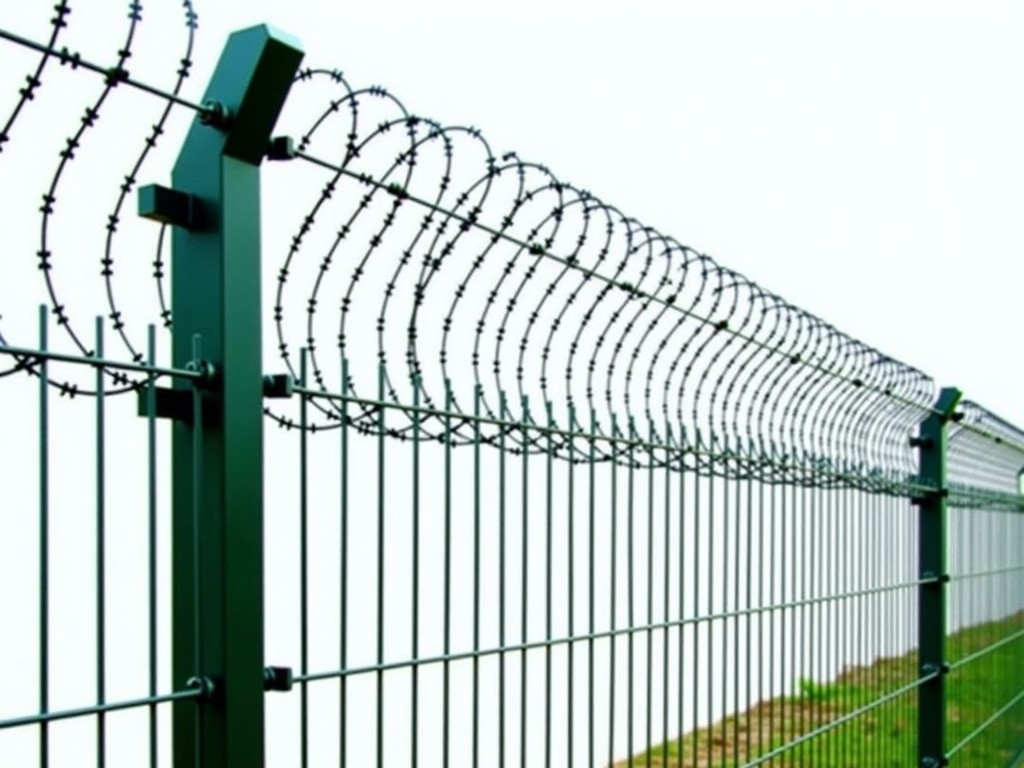
Wholesale 4 Strand Barbed Wire Fence Manufacturer
A four‑strand barbed wire fence consists of two pairs of twisted steel wires, each pair bearing uniformly spaced barbs. The configuration provides a balanced tensile load while presenting a deterrent
Wholesale 4 Strand Barbed Wire Fence Manufacturer
A four‑strand barbed wire fence consists of two pairs of twisted steel wires, each pair bearing uniformly spaced barbs. The configuration provides a balanced tensile load while presenting a deterrent obstacle for livestock and intruders. This description focuses on the structural attributes that influence performance in field installations.
Technical Specifications
| Parameter | Typical Value | Notes |
|---|---|---|
| Wire gauge (ASTM A121) | 12.5 mm (≈ 8 SWG) | Can be adjusted to 10 mm or 14 mm |
| Strand count | 4 (two twisted pairs) | Each pair twisted in opposite direction |
| Barb spacing | 75 mm | Center‑to‑center distance along the wire |
| Barb length | 15 mm | Extends from the core wire |
| Tensile strength (minimum) | 550 MPa | Measured per ASTM A370 |
| Coating type | Hot‑dip galvanized (Zn ≥ 200 g/m²) | Optional PVC over‑coat available |
| Roll length | 200 m (standard) | Custom lengths 50‑500 m on request |
| Weight per meter | 1.2 kg/m | Varies with wire diameter |
Values above represent typical production baselines; actual dimensions can be tuned to match project specifications without altering the fundamental four‑strand architecture.
Material Composition and Corrosion Protection
The core wire is produced from low‑carbon steel (grade C1010) with a carbon content below 0.10 %, providing sufficient ductility for cold‑twisting. Hot‑dip galvanization applies a zinc coating whose mass is measured in grams per square metre; a minimum of 200 g/m² yields a protective layer that retards rust formation in most outdoor environments for a decade or more.
When additional barrier protection is required, a polyvinyl chloride (PVC) over‑coat can be extruded onto the galvanized surface, increasing overall thickness by approximately 0.3 mm and offering resistance to chemical exposure in agro‑industrial settings.
Strand Construction and Barb Geometry
Each of the four strands is formed by twisting two individual wires together in opposite lay directions; this counter‑twist neutralizes torque and helps the fence maintain uniform tension after installation. Barbs are created by cutting short lengths of wire, bending them at a 45° angle, and welding them onto the core at regular intervals.
The resulting geometry yields a barb that projects outward enough to snag animal hide or clothing while remaining low enough to avoid excessive stress concentrations that could lead to wire fatigue.
Typical Applications
In agricultural settings, four‑strand barbed wire serves as a cost‑effective perimeter for pastures, deterring livestock from wandering onto roads or neighboring fields while allowing wildlife to pass through the gaps when the tension is kept moderate.
Security perimeters around industrial facilities, storage yards, and construction sites benefit from the fence’s high tensile strength and the psychological deterrent effect of visible barbs, which increases the time required for unauthorized crossing.
The design also finds use in temporary containment zones for events or disaster relief, where rapid deployment and straightforward retrieval are valued.
Quality Assurance Procedures
Every production lot undergoes tensile testing on a sample length of 1 m; the measured force must meet or exceed the 550 MPa threshold before the batch is released. Coating adhesion is verified by a cross‑hatch test according to ASTM D3359, ensuring the zinc layer remains intact after bending.
Visual inspection checks for uniform barb spacing, absence of loose ends, and proper twist direction. Each roll is labeled with a traceable code that links to the raw‑material certificate and test records.
Customization Options
- Wire diameter: selectable from 8 mm to 16 mm (SWG 8 to 4)
- Barb length: adjustable between 10 mm and 20 mm
- Barb spacing: variable from 50 mm to 100 mm
- Coating: hot‑dip galvanized only, or galvanized plus PVC over‑coat in various colors
- Roll length: custom lengths from 30 m to 800 m
- End fittings: pre‑attached tensioners, loops, or clips for rapid installation
All options are engineered to preserve the four‑strand load‑sharing principle; changes in one parameter are accompanied by a review of tensile capacity to maintain safety factors.
Packaging and Logistics
Standard rolls are wound onto a wooden core with a diameter of 150 mm, then wrapped in UV‑stabilized polyethylene film to protect against moisture during transit. Each pallet holds up to 16 rolls, secured with strapping and corner protectors.
Labeling includes product code, length, weight, and batch number; pallets are marked with handling instructions and destination details for customs clearance when shipping internationally.
Lead Time and Ordering Process
The minimum order quantity for wholesale distribution is one pallet (approximately 16 rolls). Sample lengths of 10 m can be dispatched within three working days after receipt of the request.
Production lead time varies with customization; a standard galvanized four‑strand fence typically ships within 10‑15 business days, while PVC‑coated or non‑standard barb geometries may require 18‑25 days. Quotations are prepared upon receipt of detailed specifications including wire gauge, coating type, roll length, and delivery destination.