
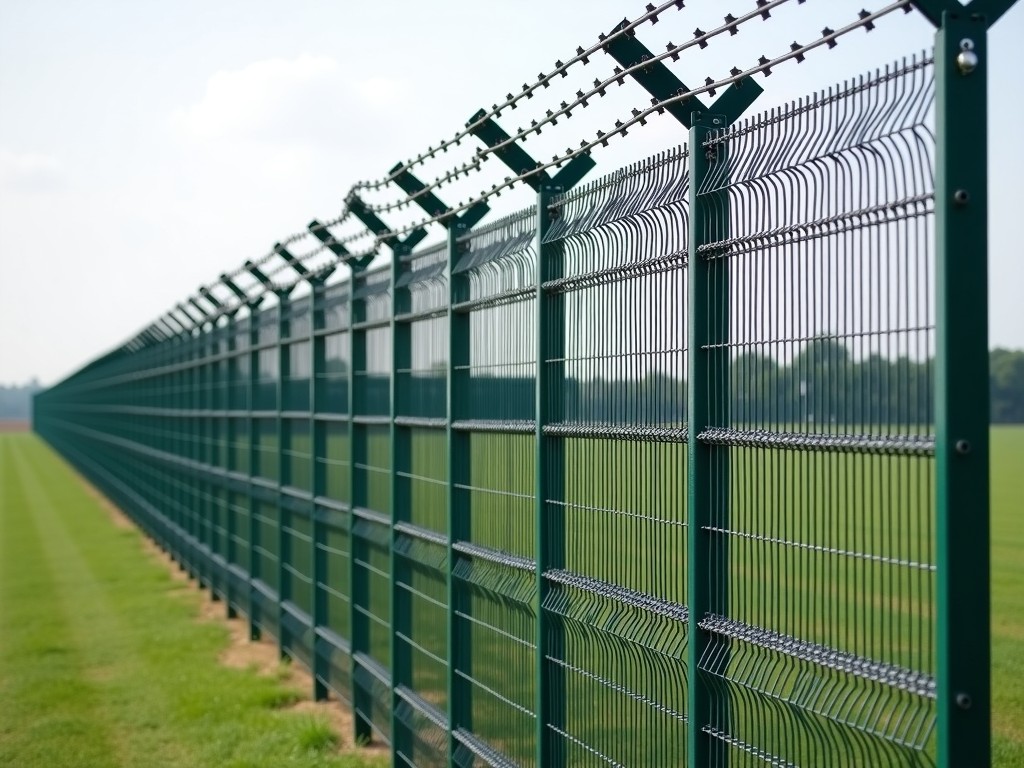
Factory Direct Galvanized Barbed Wire Mesh Fencing Exporter
Galvanized barbed wire mesh fencing combines a welded or woven steel mesh core with sharp barbs tensioned along the perimeter to deter climbing and cutting attempts. The zinc coating applied through
Factory Direct Galvanized Barbed Wire Mesh Fencing Exporter
Galvanized barbed wire mesh fencing combines a welded or woven steel mesh core with sharp barbs tensioned along the perimeter to deter climbing and cutting attempts.
The zinc coating applied through hot-dip galvanization provides a protective layer that resists corrosion in outdoor industrial environments for extended service life.
This construction yields a barrier that maintains structural integrity under wind loads, impact forces, and repeated tension cycles typical of perimeter security installations.
Material and Coating Specifications
Core wires are typically low-carbon steel rods with diameters ranging from 2.0 mm to 3.5 mm, selected based on required tensile strength and flexibility.
Hot-dip galvanization applies a zinc coating averaging 275 g/m² (approximately 20 µm thickness) uniformly over all steel surfaces, meeting ISO 1461 corrosion protection criteria.
Mechanical Properties and Dimensions
Performance characteristics depend on wire gauge, mesh aperture, and barb spacing, which can be adjusted to match site‑specific security levels.
The following table lists typical values for standard configurations; custom dimensions are available upon request.
| Parameter | Typical Value | Unit |
|---|---|---|
| Wire Diameter | 2.0–3.5 | mm |
| Mesh Opening | 50×50 | mm |
| Barb Spacing | 100–150 | mm |
| Tensile Strength | 450–550 | MPa |
| Zinc Coating Weight | 275 | g/m² |
| Roll Width | 1.0–2.5 | m |
| Roll Length | 20–50 | m |
Manufacturing Process
Wire is first drawn to the specified diameter, then cleaned and fluxed before immersion in a molten zinc bath at approximately 450 °C.
After galvanizing, the steel is formed into mesh via either welded point‑to‑point joining or weaving, depending on the required aperture uniformity.
Barbs are subsequently helically wound around the perimeter wires at the defined pitch and tensioned to ensure uniform protrusion angle.
Applications and Performance
Industrial facilities select this fencing type when a physical barrier must resist both intrusion attempts and environmental degradation.
Typical deployment scenarios include perimeter security for manufacturing plants, storage yards, transportation terminals, and agricultural enclosures.
- Manufacturing plant perimeters – prevents unauthorized access to production lines and protects valuable equipment.
- Logistics and warehousing yards – deters climbing and cutting while allowing visibility for surveillance.
- Transportation terminals (rail, freight) – secures cargo zones against tampering and vandalism.
- Agricultural facilities – contains livestock and protects crops from wildlife intrusion.
- Construction site boundaries – provides temporary yet robust enclosure that withstands repeated erection and dismantling cycles.
Quality Assurance and Testing
Each production lot undergoes dimensional verification, coating thickness measurement, and tensile testing to confirm compliance with project specifications.
Non‑destructive methods such as magnetic induction coating gauges and visual inspection under standardized lighting ensure consistent zinc coverage and barb integrity.
Customization Options
Because site conditions vary, key geometric and coating parameters can be tailored without altering the core manufacturing flow.
Adjustments are coordinated during the quotation phase to ensure lead times remain predictable.
- Wire diameter: selectable from 2.0 mm to 3.5 mm in 0.5 mm increments.
- Mesh aperture: adjustable from 30×30 mm to 100×100 mm to balance visibility and rigidity.
- Barb length and spacing: configurable between 8 mm–12 mm length and 80 mm–200 mm pitch.
- Zinc coating: upgradable to 350 g/m² for harsher corrosive environments.
- Roll width and length: customizable to match installation logistics and reduce splicing.
- Optional PVC overcoat: adds abrasion resistance and color coding for safety zones.
Packaging and Logistics
Finished rolls are wrapped in UV‑stabilized polyethylene film to protect the zinc layer during transit and storage.
Each roll is then placed on a sturdy wooden pallet with corner protectors and secured using steel straps to prevent shifting.
For export shipments, containers are loaded with moisture‑absorbent desiccants and sealed with tamper‑evident labels to meet international freight requirements.
Frequently Asked Questions
Can dimensions be customized?
Yes, wire gauge, mesh opening, barb spacing, coating weight, and roll lengths can be adjusted per project requirements; provide detailed sketches or CAD files for quotation.
What information is required before quotation?
Required details include desired wire diameter, mesh aperture, barb configuration, coating class, roll dimensions, quantity, and destination port for freight calculation.
What materials are available?
Base material is low‑carbon steel; optional stainless‑steel core or aluminum‑zinc alloy coating can be supplied upon request.
How is quality inspected?
In‑process checks involve diameter gauges, coating thickness meters, tensile test rigs, and final visual inspection under 500 lux illumination; test reports accompany each shipment.
How are export shipments protected?
Rolls are film‑wrapped, palletized, strapped, and loaded with desiccants; containers are sealed and monitored for humidity during transit.