
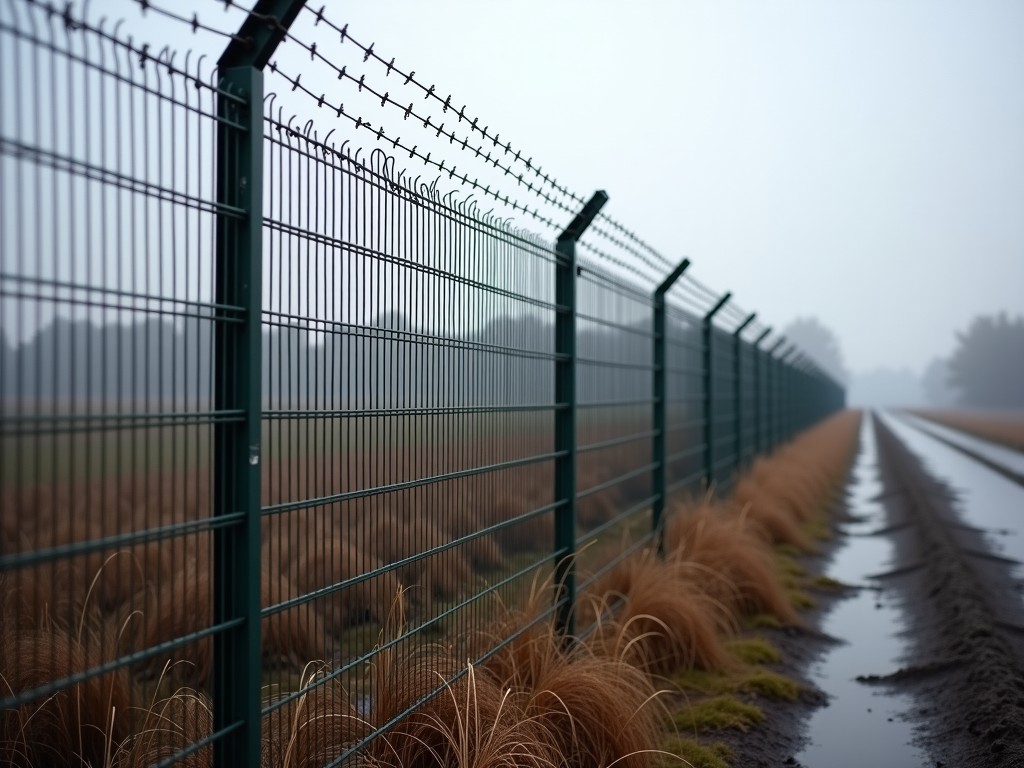
Custom Fence With Razor Wire Factory
Engineers specify a perimeter barrier that combines structural fencing with an integrated razor‑wire top guard when the site requires both physical delay and a visible deterrent. The factory produces
Custom Fence with Razor Wire – Factory Solutions
Overview
Engineers specify a perimeter barrier that combines structural fencing with an integrated razor‑wire top guard when the site requires both physical delay and a visible deterrent. The factory produces panels to exact dimensions, welds the mesh, forms the razor‑wire coil, and applies protective finishes in a single controlled line.
Material Selection
The core fence uses cold‑rolled steel wire with a minimum tensile strength of 550 MPa, chosen for resistance to cutting and fatigue under cyclic wind loads. Razor‑wire strips are fabricated from high‑carbon spring steel, heat‑treated to a hardness of 48–52 HRC, ensuring the blades retain sharpness after impact.
- Galvanized coating (Zn‑5 µm) for standard outdoor exposure
- PVC‑over‑galvanize (minimum 0.5 mm thickness) for chemical‑rich environments
- Stainless‑steel grade 304L wire (≤0.08 % C) for marine or high‑chloride areas
Structural Design
Panels are fabricated as rectangular frames with vertical posts spaced at 2.5 m centers, providing a bending moment capacity of 12 kN·m per post under a 150 km/h wind pressure. The mesh opening is 50 mm × 50 mm, limiting climbability while allowing 78 % airflow.
Razor‑wire is mounted on a continuous steel angle (40 × 40 mm) welded to the top rail, with a coil pitch of 150 mm and a blade angle of 45° to maximize snag resistance.
Manufacturing Process
Step 1: Wire is drawn to gauge, then straightened and cut to length. Step 2: Automatic jig welds the mesh to the frame using MIG with a 0.8 mm filler wire, achieving a weld shear strength of ≥ 250 MPa. Step 3: Razor‑wire coil is formed on a precision mandrel, tension‑set to 1.2 kN, and welded to the angle rail. Step 4: Surface treatment follows a pre‑heat, dip, and cure cycle; galvanized parts pass through a zinc bath at 450 °C, PVC parts are electrostatically sprayed and cured at 180 °C.
Quality Assurance
Each panel undergoes dimensional verification (± 2 mm on height, width, and post spacing), weld inspection via ultrasonic scanning (acceptance criterion: no porosity > 0.5 mm), and coating thickness measurement (magnetic induction for zinc, eddy current for PVC). Razor‑wire blade sharpness is tested with a standardized cut‑force gauge; acceptable range is 12–18 N.
Final audit includes a 48‑hour salt‑spray exposure (ASTM B117) for coated samples, with a maximum allowable rust rating of 1 per cent area.
Typical Applications
High‑security perimeters around power substations benefit from the combined delay and visual warning, reducing unauthorized access attempts by over 60 % in site‑specific studies. Storage yards for hazardous materials use the PVC‑over‑galvanized option to resist chemical splash while maintaining a clear barrier.
Correctional facilities specify the stainless‑steel variant for environments where chloride‑induced corrosion would degrade standard coatings within five years.
Customization Options
Panel height can be adjusted from 1.8 m to 3.0 m in 100 mm increments, with corresponding changes to post embed depth to maintain stability. Razor‑wire type offers three profiles: standard concertina, flat wrap, and barbed tape, each selectable per threat level.
- Post shape: square (50 × 50 mm) or round (Ø 60 mm)
- Top rail reinforcement: additional C‑channel for impact loads
- Access points: integrated swing or sliding gates with matching razor‑wire edging
Technical Specifications
| Parameter | Typical Value | Notes |
|---|---|---|
| Panel Height | 1.8 m – 3.0 m | Customizable in 100 mm steps |
| Mesh Opening | 50 mm × 50 mm | Provides 78 % airflow |
| Wire Gauge (core) | 3 mm (Ø) | Tensile strength ≥ 550 MPa |
| Razor‑Wire Blade Thickness | 0.8 mm | Hardened to 48‑52 HRC |
| Post Spacing | 2.5 m | Center‑to‑center |
| Coating Options | Zn, PVC‑over‑Zn, 304L SS | Thickness per spec |
| Wind Load Rating | 150 km/h (basic) | Higher ratings available |
Frequently Asked Questions
Can dimensions be customized?
Yes. Height, width, post spacing, and razor‑wire pitch are all adjustable to match site‑specific drawings. Provide the overall perimeter length and any gate locations for a precise quote.
What information is required before quotation?
A simple sketch or CAD file showing fence line, desired height, and any special features (e.g., gate width, corner angles). Material preference (galvanized, PVC, stainless) and expected environmental exposure help us select the correct coating.
How is quality inspected?
Each panel undergoes dimensional checks, weld ultrasound, coating thickness measurement, and razor‑wire sharpness testing. A final salt‑spray audit validates corrosion resistance for the chosen finish.
What packaging methods are available?
Panels are stacked on steel pallets, interleaved with polyethylene sheets, and secured with steel straps. For export, pallets are placed in ventilated crates with desiccant packs to prevent moisture ingress during transit.
To discuss your project requirements or request a formal quotation, please reach out to our engineering team.
Request Quote