
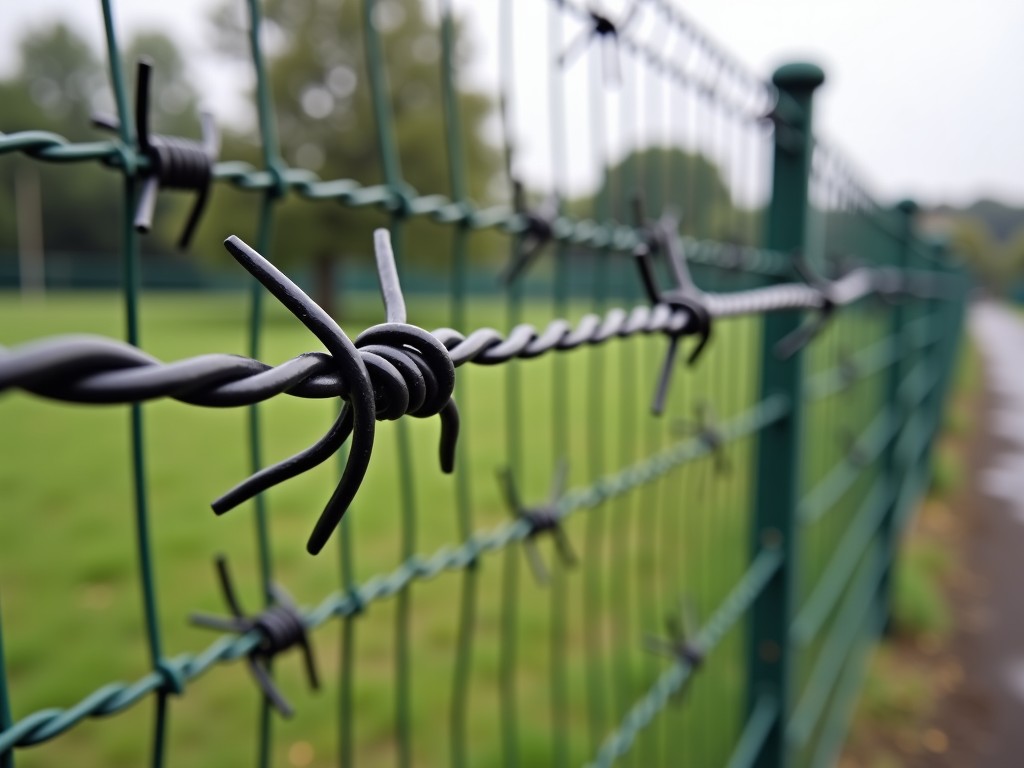
Custom Double Twisted Barbed Wire Manufacturer
Double twisted barbed wire consists of two strands helically twisted together, with barbs formed by cutting and twisting short lengths of wire around the core. This configuration increases torsional
Custom Double Twisted Barbed Wire Manufacturer
Double twisted barbed wire consists of two strands helically twisted together, with barbs formed by cutting and twisting short lengths of wire around the core. This configuration increases torsional rigidity and resistance to unraveling compared with single‑strand designs, making it suitable for high‑tension perimeter barriers where sustained load and impact are expected.
Key Specifications
| Parameter | Typical Range | Notes |
|---|---|---|
| Core wire diameter | 2.0 mm – 3.2 mm | Measured before twisting |
| Twist pitch | 50 mm – 100 mm | Distance for one full helical turn |
| Barb spacing | 75 mm – 150 mm | Center‑to‑center distance along the wire |
| Tensile strength (core) | 800 MPa – 1200 MPa | Dependent on steel grade and coating |
| Coating thickness (galvanized) | 10 µm – 25 µm Zn | Uniform coating per ISO 1461 |
Material Options
The core wire is typically produced from low‑carbon steel (SAE 1008–1010) or higher‑strength grades (SAE 1045) when increased break load is required. Surface protection can be hot‑dip galvanized, zinc‑aluminum alloy (Galvalume), or a PVC overcoat for additional corrosion resistance and visual identification. Each option influences the wire’s elongation at break, UV stability, and service life in specific environments.
- Low‑carbon steel – standard tensile, economical
- Medium‑carbon steel – higher yield, suitable for tensioned fences
- Hot‑dip galvanized – sacrificial zinc layer, typical for outdoor exposure
- PVC coated – added barrier against chemicals, available in multiple colours
Customization Capabilities
Manufacturers can adjust the helix direction (right‑hand or left‑hand twist), modify barb geometry (sharp point, rounded tip, or reinforced flange), and vary the overall coil length to match site‑specific installation constraints. Coating thickness and alloy composition are tailored according to corrosivity classifications (C1–C5) defined in ISO 9223, ensuring the product meets expected durability without over‑engineering.
- Twist direction – influences handling and compatibility with tensioning equipment
- Barb length – typically 15 mm–30 mm, adjustable for threat level
- Coil inner diameter – 450 mm–600 mm for standard dispensing reels
- Weight per coil – 15 kg–50 kg, based on length and wire gauge
Applications and Functional Rationale
Double twisted barbed wire is employed in livestock enclosures where the combined tensile strength resists impact from large animals, and the interlocking twist reduces the chance of strand separation under repeated loading. In high‑security perimeters, the dual‑strand construction provides a higher moment of inertia, making the barrier more resistant to cutting tools that attempt to shear a single strand. The design also facilitates easier tensioning because the two strands share the load, allowing lower pre‑tension values while maintaining equivalent barrier rigidity.
Quality Control Philosophy
Each production lot undergoes tensile testing on randomly selected samples to verify that the actual break load matches the specification range. Barb adhesion is assessed by applying a calibrated peel force; the coating thickness is measured with a magnetic induction probe at multiple points along the coil. Visual inspection under 10× magnification checks for defects such as uneven twists, barb deformation, or coating holidays. Results are documented and traceable to the specific wire heat number.
- Tensile test – ASTM A370, sampling 1 per 1000 kg
- Coating thickness – ISO 1461, ±2 µm tolerance
- Barb peel strength – minimum 12 N per barb
- Visual defect limit – <0.5 % of length
Packaging and Logistics
Finished coils are wrapped in UV‑stabilized polyethylene film to prevent moisture ingress during transit, then placed on wooden pallets with corner protectors. Each pallet is strapped with polyester bands and labeled with coil weight, length, material grade, and coating type. For overseas shipments, pallets are fitted with heat‑treated wooden skids compliant with ISPM‑15 to avoid customs delays. This packaging approach minimizes corrosion risk and maintains wire integrity until point‑of‑use.
- Film thickness – 50 µm LDPE
- Pallet size – 1100 mm × 1100 mm (standard)
- Maximum stack height – 2 pallets (static load)
- Labeling – barcode and human‑readable lot number
Frequently Asked Questions
Can dimensions be customized?
Yes, wire diameter, twist pitch, barb spacing, and coil length are all adjustable according to project requirements. Customers provide the desired mechanical performance or environmental class, and the manufacturer derives the appropriate specifications.
What information is required before quotation?
To generate an accurate quote, the buyer should supply the intended application (e.g., livestock fence, security perimeter), required tensile strength or load, corrosion environment (indoor, outdoor, marine), and any dimensional constraints such as maximum coil weight or length. Optional details include preferred coating type and delivery timeline.
How is quality inspected?
Quality control includes tensile testing of random samples, coating thickness measurement via magnetic induction, barb adhesion peel tests, and visual inspection for twists or defects. All tests follow recognized industry standards and results are retained for traceability.
What packaging methods are available?
Standard packaging uses UV‑stabilized polyethylene film wrapped coils on wooden pallets with polyester strapping. For export, ISPM‑15 compliant skids and additional corner protection can be provided upon request.
What is the typical production lead time?
Lead time varies with order size and customization complexity but generally ranges from 2 to 4 weeks for standard specifications. Specialized coatings or non‑standard lengths may extend this period, which is confirmed at quotation stage.
Contact for Technical Inquiry
For detailed specifications, customization options, or to request a sample, please reach out to our engineering team via the contact form. Provide your project parameters and we will respond with a tailored quotation and lead‑time estimate.
Contact Us