
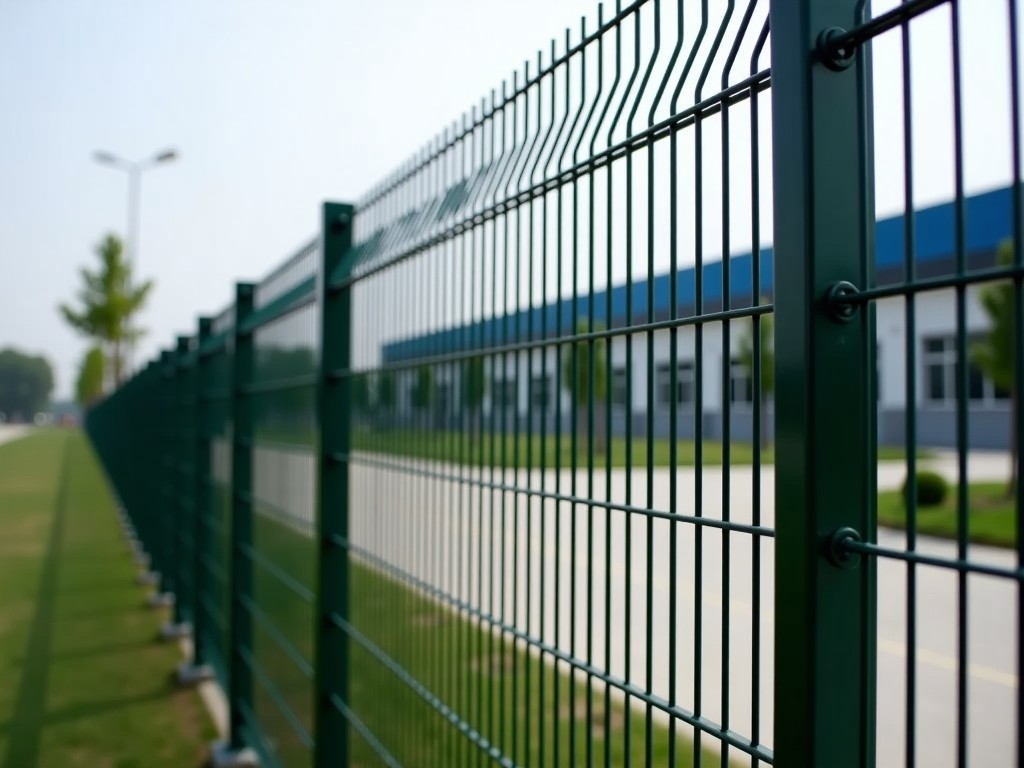
China Security Razor Wire Mesh Fence Factory
Security razor wire mesh fence combines high‑tensile steel wire with uniformly spaced barbs to create a deterrent barrier that resists cutting and climbing. The mesh configuration distributes load
China Security Razor Wire Mesh Fence Factory
Security razor wire mesh fence combines high‑tensile steel wire with uniformly spaced barbs to create a deterrent barrier that resists cutting and climbing.
The mesh configuration distributes load across the panel, maintaining structural integrity under tension while allowing visibility for surveillance.
Design and Construction
Core wire is cold‑drawn to a diameter ranging from 2.0 mm to 3.5 mm, providing a tensile strength typically between 1 500 MPa and 2 000 MPa.
Barbs are formed by twisting two lengths of wire around the core at a pitch of 40 mm to 60 mm, creating sharp protrusions with an average length of 15 mm to 25 mm.
Resulting mesh openings are usually 50 mm × 50 mm or 75 mm × 75 mm, selected based on the required balance between obstruction and airflow.
Material Options
Base steel can be supplied as low‑carbon Q195, high‑strength Q345, or stainless grades 304 and 316, each offering different corrosion resistance and mechanical properties.
Surface treatments include hot‑dip galvanization (zinc coating 60–120 g/m²), electrogalvanization, or PVC coating in colors such as black, green, or gray.
For aggressive environments, a duplex system of galvanization followed by a polymer overcoat extends service life beyond 20 years in marine atmospheres.
Manufacturing Process
Wire drawing reduces the rod to the target diameter while improving grain structure and strength.
Barb formation occurs on a high‑speed twisting machine where two helper wires are helically wound around the core at controlled tension.
After barb application, the welded mesh is assembled by spot‑welding intersecting wires at each node, ensuring a joint shear strength exceeding 80 % of the base wire tensile capacity.
Technical Specifications
Standard product ranges are defined by the following parameters, which can be adjusted to match project requirements.
| Parameter | Typical Value | Unit |
|---|---|---|
| Core wire diameter | 2.0 – 3.5 | mm |
| Barb length | 15 – 25 | mm |
| Barb pitch | 40 – 60 | mm |
| Mesh opening | 50 × 50 or 75 × 75 | mm |
| Tensile strength | 1 500 – 2 000 | MPa |
| Zinc coating weight | 60 – 120 | g/m² |
| Roll width | 1.0 – 2.5 | m |
| Roll length | 20 – 50 | m |
Custom diameters, coatings, and lengths are available upon request, subject to minimum order quantities.
Applications
Facilities that require delayed intrusion detection benefit from the fence’s ability to cause snagging and injury to unauthorized climbers, thereby increasing the time required for breach.
Correctional institutions, military perimeters, and critical infrastructure sites commonly specify razor wire mesh because it maintains visibility for CCTV while presenting a formidable physical obstacle.
Industrial storage yards and substations use the product to deter theft of copper and equipment, reducing insurance premiums in some jurisdictions.
- Correctional facilities
- Military bases
- Power substations
- Water treatment plants
- Border security
- Private industrial parks
Customization Options
Buyers can tailor the fence to site‑specific threat levels and aesthetic constraints.
Options include varying barb geometry (single, double, or concertina), adjusting coil diameter for different mounting heights, and selecting coating color to match surrounding architecture.
Additional services such as pre‑cut panels, integrated tensioning hardware, and anti‑clover coatings are offered to simplify installation.
- Barb type (single, double, concertina)
- Coil diameter (height of fence)
- Panel length
- Coating type (galvanized, PVC, stainless)
- Color (black, green, gray, custom)
- Accessories (tension brackets, barbed extensions)
Quality Control
Each production lot undergoes dimensional verification using laser micrometers to confirm wire diameter and barb spacing within ±0.1 mm.
Tensile tests are performed on sampled strands to ensure the ultimate tensile strength meets the specified minimum.
Coating adhesion is assessed by cross‑hatch tape testing, and zinc weight is verified via gravimetric stripping according to ISO 1461.
Visual inspection checks for uniform barb formation and absence of weld defects before coiling.
Packaging and Shipping
Finished coils are wrapped in UV‑stabilized polyethylene film to protect the coating during transit.
Coils are then placed on steel pallets with corner protectors and secured with polyester straps to prevent shifting.
For ocean freight, desiccant packs are included and containers are lined with moisture‑barrier sheeting to limit corrosion risk.
Frequently Asked Questions
- Can dimensions be customized? Yes, wire diameter, barb length, mesh opening, and roll length can be adjusted to project specifications.
- What information is required before quotation? Required details include desired height, coating type, quantity, delivery location, and any applicable standards.
- What materials are available? Base steels Q195, Q345, 304 stainless, 316 stainless with hot‑dip galvanization, electrogalvanization, or PVC coating.
- How is quality inspected? Dimensional checks, tensile testing, coating adhesion tests, and visual inspection are performed on each lot.
- What packaging methods are available? Standard packaging uses UV‑stabilized film, steel pallets, and polyester straps; moisture‑barrier lining is offered for sea shipments.
- How are export shipments protected? Desiccant packs and moisture‑barrier liners mitigate corrosion during transit.
- What is the typical production lead time? Lead time varies with order size and customization, typically ranging from 15 to 30 working days after confirmation.
- How are samples arranged? Samples can be provided upon request; shipping costs are usually borne by the requester.
Contact Us
For technical quotations or to discuss project‑specific requirements, please send an inquiry.
Send Inquiry