
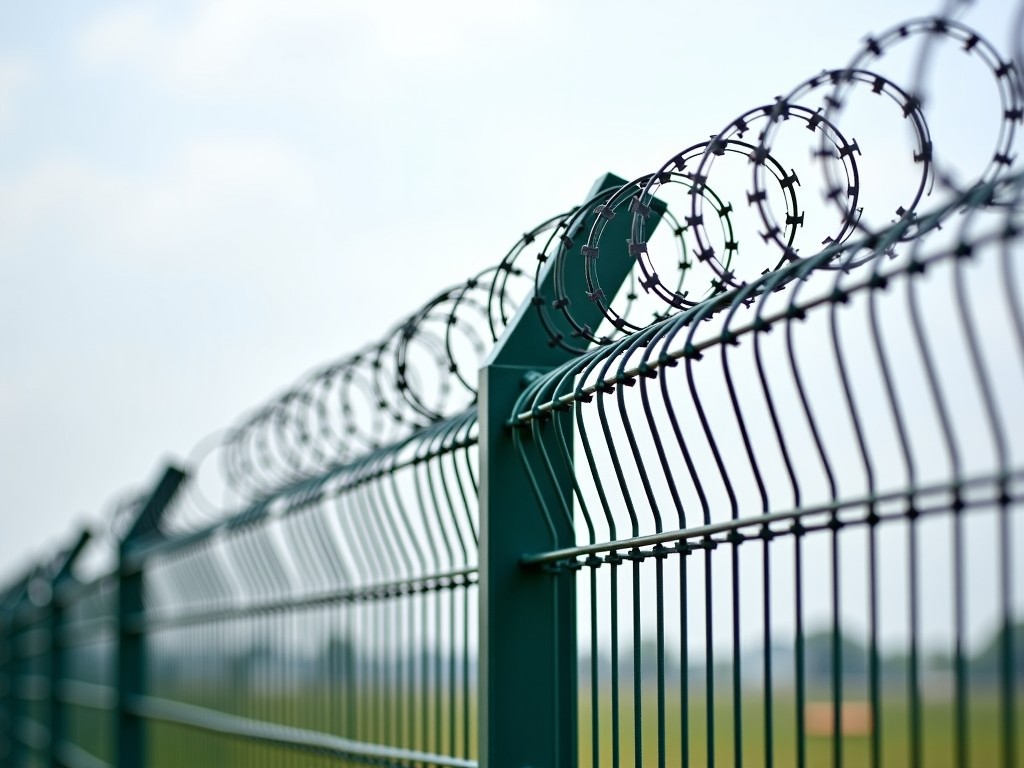
China Razor Wire Fence Wholesale Supplier
Razor wire fence consists of sharp-edged steel tape helically wound around a high‑tensile core wire, forming a continuous barrier that deters climbing and cutting. The assembly is typically
China Razor Wire Fence Wholesale Supplier
Razor wire fence consists of sharp-edged steel tape helically wound around a high‑tensile core wire, forming a continuous barrier that deters climbing and cutting. The assembly is typically galvanized or coated to resist corrosion in outdoor environments. Wholesale suppliers source the product directly from manufacturers, offering bulk coils or pre‑assembled panels to contractors, distributors, and security firms.
Product Overview
The core wire provides tensile strength, usually ranging from 2.5 mm to 4.0 mm diameter, while the razor tape features protruding blades spaced at 10 mm to 15 mm intervals. When installed, the tape overlaps to create a jagged surface that increases the force required to breach the fence. This design balances material efficiency with effective perimeter protection.
Technical Specifications
| Parameter | Typical Value | Notes |
|---|---|---|
| Core wire diameter | 2.5 mm – 4.0 mm | Cold‑drawn high‑carbon steel |
| Razor tape thickness | 0.5 mm – 0.8 mm | Stamped from hardened steel strip |
| Blade pitch | 10 mm – 15 mm | Center‑to‑center distance |
| Coating | Hot‑dip galvanized (Z275) or PVC | Optional color‑top coating available |
| Coil length | 10 m – 50 m per coil | Custom lengths per project |
Materials and Construction
Core wires are produced from SAE 1080 or equivalent high‑carbon steel, drawn to achieve a minimum tensile strength of 1 700 MPa. Razor tape is stamped from cold‑rolled steel strip hardened to HRC 45‑50, then sharpened to a blade angle of approximately 30°. After forming, the assembly undergoes hot‑dip galvanizing per ISO 1461, delivering a zinc coating weight of at least 275 g/m² for corrosion resistance in humid or marine atmospheres.
Manufacturing Process
Wire drawing reduces the rod to the target diameter while preserving metallurgical properties. The core wire is then fed through a forming head where the razor tape is wound under controlled tension, ensuring uniform pitch and blade orientation. Post‑winding, the coiled product passes through a cleaning station, flux immersion, and a zinc bath at approximately 450 °C before being cooled and inspected for coating continuity.
Applications
Perimeter security for industrial facilities relies on razor wire because its sharp blades increase the time and effort required for unauthorized entry, thereby supporting detection and response timelines. Correctional institutions use the fence as a secondary barrier atop walls, where the overlapping tape creates a continuous hostile surface that discourages scaling. Military bases and critical infrastructure sites select galvanized razor wire for its ability to withstand prolonged exposure to weather while maintaining deterrent performance.
Quality Assurance
Dimensional checks verify core wire diameter and tape pitch using calibrated gauges with ±0.02 mm tolerance. Coating thickness is measured by magnetic induction probes, ensuring compliance with the specified zinc weight. Visual inspection examines blade sharpness and uniformity, rejecting any coil with deformed or blunted edges. Tensile tests on core wire samples confirm that the minimum break load meets the design specification before shipment.
Customization Options
Clients may request alternative core wire diameters to match specific load requirements, or select stainless‑steel grades (e.g., 304 or 316) for environments with high chloride exposure. Blade geometry can be adjusted—such as increasing blade height or altering the pitch—to tailor the deterrent level. Coil length, packaging format, and end‑finishing (e.g., looped or straight ends) are also defined per project specifications.
Packaging and Shipping
Coils are wrapped in UV‑stabilized polyethylene film to guard against moisture during transit, then placed on wooden pallets with corner protectors to prevent deformation. For larger volumes, panels are stacked flat with interleaving cardboard sheets and secured with steel straps. Each pallet carries a label indicating product code, coil length, coating type, and batch number, facilitating traceability from factory to destination.
Frequently Asked Questions
- Can dimensions be customized? Yes, core diameter, tape thickness, blade pitch, and coil length can be adjusted according to project requirements.
- What information is needed for a quotation? Required details include desired core wire diameter, tape specifications, coating type, total length or number of panels, and delivery destination.
- Which materials are available? Standard offering uses high‑carbon steel with hot‑dip galvanization; optional stainless‑steel grades and PVC coating are available upon request.
- How is quality inspected? Each batch undergoes dimensional verification, coating thickness measurement, visual blade inspection, and tensile testing before release.
- What packaging methods are used? Coils are film‑wrapped and palletized; panels are flat‑stacked with interleaving protection and strapping.
- How are export shipments protected? Pallets receive corner boards, stretch film, and, when needed, desiccant bags to control humidity inside the container.
- What is the typical lead time? Production lead time ranges from 10 to 25 days depending on order size and customization level, confirmed at quote stage.
Contact for Quotation
To receive a detailed price and lead‑time estimate, provide your project specifications via the inquiry form. Our technical team will review the requirements and return a formal quote within one business day.
Request Quote