
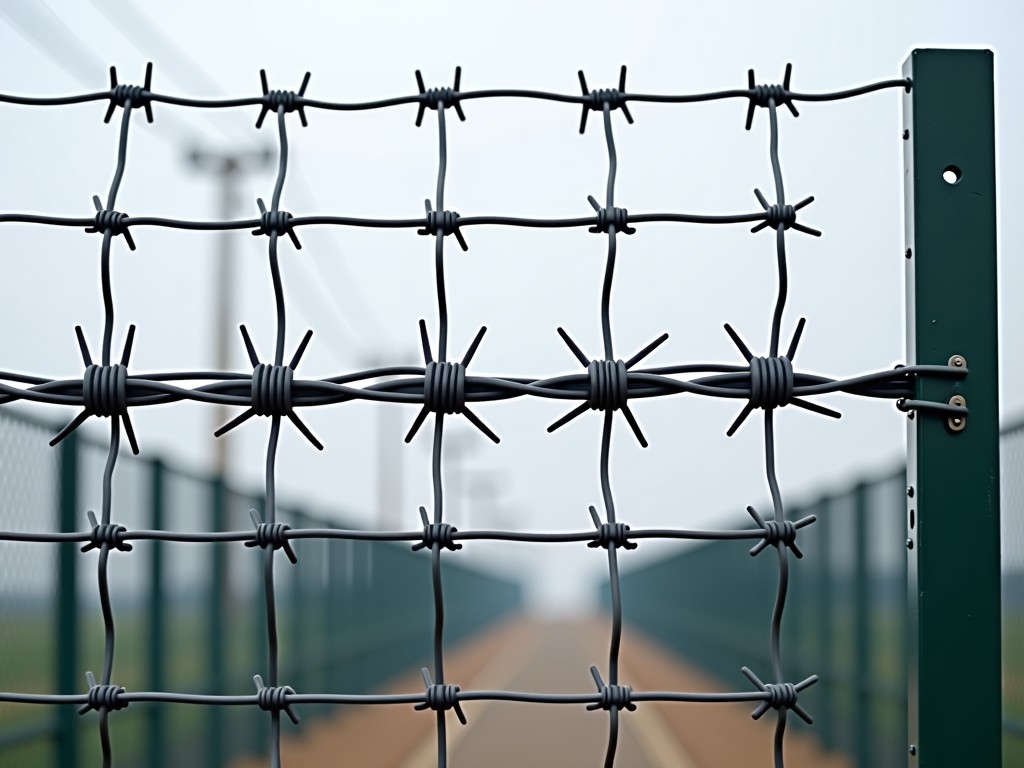
China Razor Barbed Wire Custom Manufacturer
Razor barbed wire combines a high‑tensile steel core with sharply angled barbs that deter climbing and cutting attempts. The product is formed by cold‑drawing steel wire to a precise diameter, then
China Razor Barbed Wire Custom Manufacturer
Razor barbed wire combines a high‑tensile steel core with sharply angled barbs that deter climbing and cutting attempts. The product is formed by cold‑drawing steel wire to a precise diameter, then shaping the barbs and securing them along the core at defined intervals. This construction yields a barrier that resists tensile loads while presenting a low‑profile, difficult‑to‑penetrate obstacle.
Material Options
| Parameter | Typical Value | Notes |
|---|---|---|
| Core wire material | Low‑carbon steel (SAE 1008/1010) | Available in galvanized or PVC‑coated finishes |
| Tensile strength | ≥ 550 MPa | Measured per ASTM A370 |
| Coating thickness (galvanized) | 8–12 µm Zn | Provides corrosion resistance for outdoor exposure |
| PVC coating (optional) | 0.5–1.0 mm thickness | Adds UV stability and color options (black, green, yellow) |
Customization Parameters
- Core wire diameter: 1.2 mm – 2.5 mm (customizable per load requirements)
- Barb length: 15 mm – 30 mm (affects deterrence level)
- Barb spacing along core: 50 mm – 150 mm (adjustable for coverage density)
- Coil length per roll: 10 m – 100 m (standard packaging units)
- Finish: hot‑dip galvanized, electro‑galvanized, or PVC‑coated (color selectable)
Typical Applications
Industrial facilities use razor barbed wire atop perimeter fences to prevent unauthorized climbing; the sharp profile raises the force required to breach the barrier, reducing the likelihood of successful intrusion. Correctional institutions select the product because its low‑profile geometry limits the ability to fashion makeshift tools, while the high tensile strength maintains integrity under sustained tension. Military bases and high‑value storage sites specify razor barbed wire for its combination of minimal visual obstruction and maximal deterrent effect, meeting security standards that require both durability and rapid deployment.
Technical Specifications
| Specification | Range / Value | Test Standard |
|---|---|---|
| Wire diameter | 1.2 mm – 2.5 mm | ASTM A228 |
| Barb angle | 30° – 45° from core axis | Manufacturer drawing |
| Coil weight (approx.) | 5 kg – 25 kg per roll | Dependent on diameter & length |
| Tensile strength (core) | ≥ 550 MPa | ASTM A370 |
| Elongation at break | ≥ 10% | ASTM A370 |
Quality Assurance
Each production lot undergoes dimensional verification using laser micrometers to confirm wire diameter and barb spacing within ±0.05 mm. Tensile tests are performed on sampled cores to ensure the material meets the specified strength threshold. Coating thickness is measured with magnetic induction probes for galvanized layers and ultrasonic gauges for PVC finishes. Visual inspection checks for uniform barb formation and absence of defects such as cracks or uneven coating before products are cleared for packaging.
Packaging & Logistics
Finished coils are wrapped in UV‑stabilized stretch film, placed on wooden pallets, and secured with steel straps. A volatile corrosion inhibitor (VCI) sheet is added between layers to protect galvanized surfaces during transit. Standard 20‑foot containers accommodate up to 24 pallets, allowing efficient shipment to overseas destinations while maintaining product integrity.
Frequently Asked Questions
- Q: Can the barb length and spacing be adjusted for a specific security level?
A: Yes, both parameters are fully customizable; longer barbs and tighter spacing increase climb resistance. - Q: What information is needed to obtain a quotation?
A: Required details include desired wire diameter, barb length, spacing, coil length, finish type, and quantity. - Q: Which material finishes are available for corrosive environments?
A: Hot‑dip galvanized (≥8 µm Zn), electro‑galvanized, and PVC‑coated options are offered; PVC provides additional UV stability. - Q: How is product quality verified before shipment?
A: Each lot undergoes dimensional checks, tensile testing, coating thickness measurement, and visual inspection per internal QA procedures. - Q: What lead time should be expected for a custom order?
A: Typical production lead time ranges from 2 to 4 weeks after receipt of final specifications, depending on order size and finish complexity.
Contact for Custom Quote
To discuss your project requirements and receive a detailed quotation, please reach out to our technical sales team.
Request a Quote