
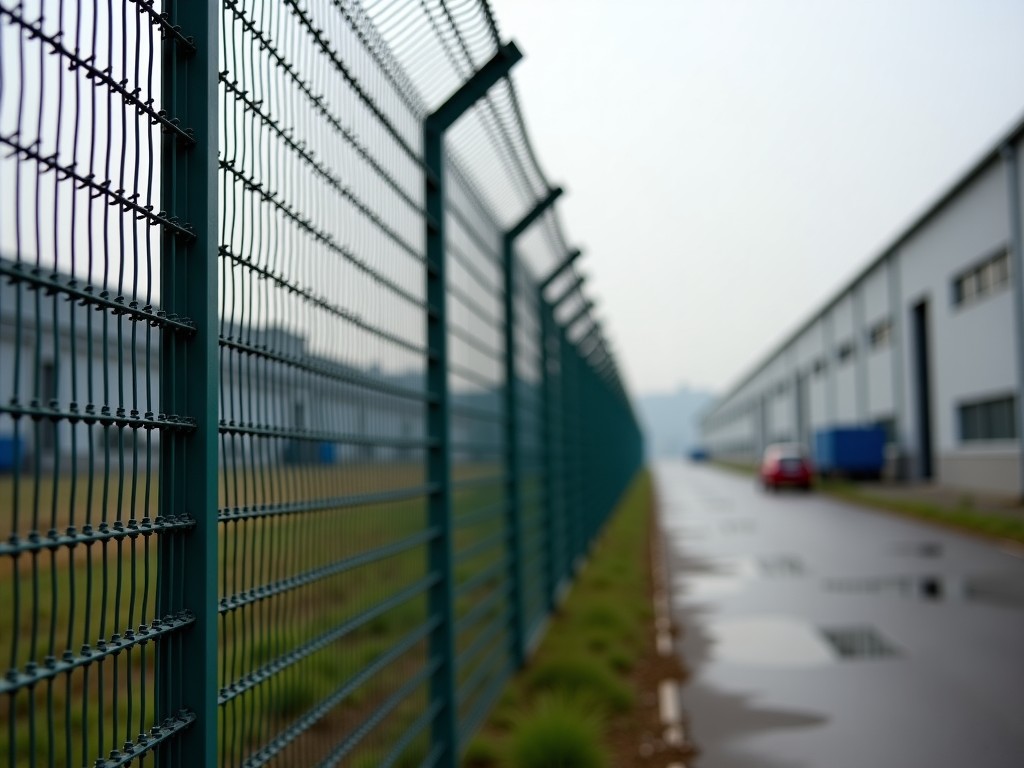
China Fence With Razor Wire Factory
A razor wire fence combines high‑tensile steel wire with sharply edged barbs to create a physical barrier that deters climbing and cutting. The system is engineered for permanent installation where
China Fence with Razor Wire Factory
A razor wire fence combines high‑tensile steel wire with sharply edged barbs to create a physical barrier that deters climbing and cutting. The system is engineered for permanent installation where unauthorized access must be prevented with minimal ongoing maintenance.
Core Design and Materials
The fence core is typically made from low‑carbon steel wire with a diameter ranging from 2.0 mm to 3.0 mm, providing a tensile strength of 550 MPa to 650 MPa. Razor barbs are formed from the same wire stock, pressed into a helical profile with a pitch of 15 mm to 20 mm and a blade thickness of 0.8 mm. To resist corrosion, the wire is hot‑dip galvanized to a minimum coating weight of 275 g/m², or optionally coated with a 50 µm PVC layer for additional chemical resistance.
Structural Configuration
Standard panels are fabricated in lengths of 2.0 m to 3.0 m and heights of 1.8 m, 2.2 m, or 2.6 m. Posts are spaced at 2.5 m intervals and are usually made from galvanized steel tubes with a wall thickness of 2.0 mm. The razor wire is tensioned between posts using pre‑stressed clamps that maintain a nominal tension of 1.5 kN, ensuring the barbs remain rigid and the panel resists sagging under wind loads up to 150 Pa.
Performance Characteristics
The galvanized coating provides a corrosion rate of less than 5 µm/year in neutral atmospheres, translating to an expected service life of 20 years without significant degradation. In aggressive environments (e.g., coastal salt spray), the PVC overcoat extends life to 25 years. The fence resists impact energies up to 150 J before permanent deformation, making it suitable for high‑risk perimeters.
Typical Specifications
| Parameter | Typical Value | Unit |
|---|---|---|
| Wire diameter | 2.0 – 3.0 | mm |
| Razor barb pitch | 15 – 20 | mm |
| Panel height | 1.8 – 2.6 | m |
| Post spacing | 2.5 | m |
| Galvanized coating weight | ≥275 | g/m² |
| Tensile strength | 550 – 650 | MPa |
| Expected service life (neutral) | 20 | years |
Industrial Applications
Prisons and detention centers employ razor wire fences because the sharp barbs increase the time required for an intruder to breach the perimeter, allowing security personnel to respond. Electrical substations use the same system to deter vandalism and prevent unauthorized access to live equipment, reducing the risk of outages. Military bases select razor wire for its low visual profile combined with high deterrence, enabling rapid deployment on temporary forward operating bases. In each case, the fence’s low maintenance requirement—no painting or frequent tightening—lowers total cost of ownership over its service life.
Customization Options
Manufacturers can adjust panel length, height, and post spacing to match site‑specific constraints. Razor barb geometry can be varied (e.g., tighter pitch for higher deterrence or larger blade for increased cutting resistance). Coating choices include hot‑dip galvanization, galvan‑plus‑PVC, or stainless‑steel wire for extreme corrosion environments. Post materials may be switched to rectangular steel tubes or concrete‑filled steel for added impact resistance. Additional accessories such as anti‑climb rollers, tension monitors, and integrated lighting brackets are available upon request.
- Panel length: 1.5 m – 4.0 m
- Height: 1.5 m – 3.0 m
- Barb pitch: 10 mm – 25 mm
- Coating: galvanized, PVC‑overcoat, stainless steel
- Post type: round tube, square tube, concrete‑filled
Quality Control and Testing
Each production lot undergoes dimensional verification of wire diameter and barb pitch using calibrated micrometers. Coating adhesion is tested by the ASTM D4541 pull‑off method, ensuring a minimum bond strength of 5 MPa. Tensile samples are pulled to failure to confirm compliance with the specified strength range. Corrosion resistance is validated via salt‑spray testing (ASTM B117) for 500 hours, after which the coating is inspected for rust penetration. Final assemblies are proof‑loaded to 1.2 times the design tension to detect any weak links before shipment.
Packaging and Logistics
Panels are bundled in groups of five, wrapped with UV‑stabilized polyethylene film, and placed on steel pallets equipped with corner protectors. Each pallet is marked with weight, dimensions, and handling instructions. For overseas shipments, pallets are loaded into 20‑foot or 40‑foot containers with moisture‑absorbing desiccants and secured with steel straps to prevent movement. Documentation includes material test reports, coating certificates, and a packing list that matches the purchase order.
Frequently Asked Questions
Can dimensions be customized? Yes, panel length, height, and post spacing are adjustable to meet project specifications; custom lengths up to 4.0 m are available.
What information is required before quotation? Required details include desired panel dimensions, coating type, post material, quantity, and any special accessories (e.g., tension monitors, lighting brackets).
What materials are available for the wire and posts? Wire options: low‑carbon steel with galvanized, PVC‑overcoat, or stainless steel. Post options: galvanized round tube, square tube, or concrete‑filled steel.
How is quality inspected? Inspection includes dimensional checks, coating adhesion (ASTM D4541), tensile testing, salt‑spray corrosion resistance (ASTM B117), and proof‑loading of assembled panels.
What packaging methods are available? Standard packaging uses UV‑stabilized film wrapping and steel pallets; custom packaging such as crate‑packing or corrosion‑inhibitor treated wraps can be arranged.
How are export shipments protected? Pallets are secured with steel straps, loaded with desiccants, and containerized to prevent moisture ingress and movement during transit.
What is the typical production lead time? Lead time ranges from 15 to 30 working days depending on order size and coating selection; expedited schedules are possible for stocked items.
How are samples arranged? Sample panels (up to 1.0 m length) can be shipped via express courier; the client covers freight costs, and sample fees are credited toward a subsequent order.
For technical inquiries or to request a formal quotation, please contact our sales team.