
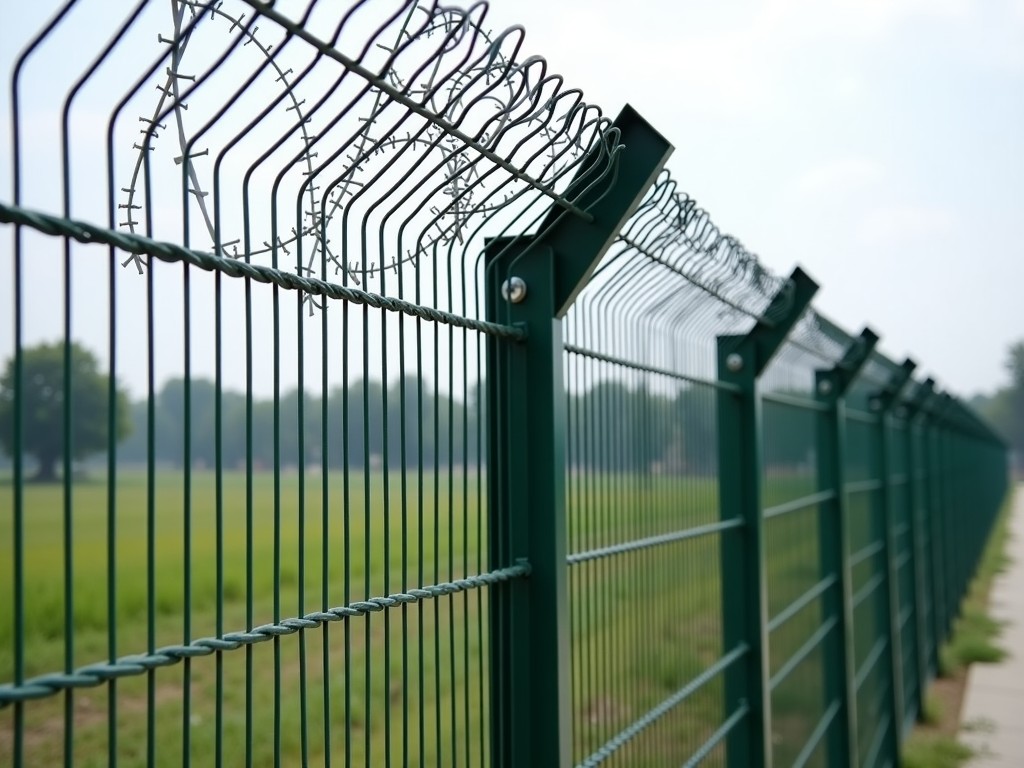
China Durable Fence With Razor Wire Supplier
Perimeter security systems often require a barrier that combines structural strength with a deterrent layer capable of delaying unauthorized access. A steel fence integrated with razor wire provides
Durable Fence with Razor Wire – China Supplier
Perimeter security systems often require a barrier that combines structural strength with a deterrent layer capable of delaying unauthorized access. A steel fence integrated with razor wire provides both mechanical resistance and a psychological obstacle, reducing the likelihood of breach attempts. This combination is frequently specified for sites where intrusion risk must be minimized over long service periods.
Technical Specifications
| Parameter | Typical Value | Unit |
|---|---|---|
| Fence height (panel) | 2.4 – 3.0 | m |
| Post spacing | 2.5 (standard) | m |
| Steel core wire diameter | 3.0 | mm |
| Razor wire blade thickness | 0.5 | mm |
| Hot‑dip galvanized zinc coating | ≥ 275 | g/m² |
| Tensile strength of steel core | ≥ 550 | MPa |
| Design wind load resistance | up to 1500 | Pa |
Values shown are typical ranges; actual dimensions and coatings can be adjusted to meet specific project requirements such as higher wind zones or stricter corrosion classifications.
Applications
Facilities that demand a high level of perimeter deterrence include military installations, correctional centers, substations, and storage sites for valuable commodities. In these environments, the primary concern is not only preventing climbing but also increasing the time required for an intruder to overcome the barrier, allowing security personnel to respond. The razor wire component adds a sharp‑edge obstacle that significantly raises the effort needed to cut or climb the fence.
Industrial complexes located near borders or in areas with elevated theft risk often select this system because it can be installed on existing concrete foundations or steel posts without major civil works. The modular panel design enables rapid deployment while maintaining consistent tension across the wire.
Materials & Construction
The fence panels are fabricated from low‑carbon steel wires that are cold‑drawn to achieve uniform diameter and tensile properties. After forming the mesh, the entire panel undergoes hot‑dip galvanizing, which creates a zinc‑iron alloy layer providing sacrificial protection against rust. The razor wire is produced from hardened steel strip, shaped into sharp barbs, and then similarly galvanized to ensure compatibility with the fence coating.
Posts are typically made from rectangular or circular steel tubing, also hot‑dip galvanized, and are equipped with base plates for anchoring to concrete or driven into soil. Tensioning hardware, such as ratchet turnbuckles or strain‑insulators, is fabricated from stainless steel to avoid galvanic coupling with the zinc‑coated components.
Customization Options
- Panel height adjustable from 1.8 m to 3.5 m in 0.1 m increments
- Post spacing customizable between 2.0 m and 3.0 m to suit site layout
- Coating choices: standard hot‑dip galvanized, PVC‑over‑galvanized for color coding, or stainless‑steel core for aggressive environments
- Razor wire configuration: single coil, double coil, or concertina style with variable barb spacing
- Integration of swing or sliding gates with matching razor‑wire over‑hang and lockable hardware
Each option is engineered to maintain structural integrity; for example, increasing height does not reduce post capacity because the design incorporates larger moment‑resisting sections where needed.
Quality Assurance
Dimensional checks are performed on every batch using calibrated laser gauges to verify wire diameter, panel dimensions, and barb geometry within ±0.1 mm tolerances. Coating thickness is measured with magnetic‑induction probes, ensuring the zinc layer meets the specified minimum before shipping. Mechanical validation includes tensile testing of random wire samples to confirm strength exceeds the declared 550 MPa threshold.
Visual inspection looks for defects such as missed galvanizing spots, sharp edges on the mesh that could cause injury during handling, and proper alignment of tensioning hardware. All inspection results are documented and traceable to the specific production lot.
Packaging & Shipping
Panels are bundled in groups of five, wrapped in UV‑stabilized polyethylene film, and placed on steel pallets with corner protectors to prevent deformation during transit. Razor‑wire coils are secured in corrugated cardboard sleeves with end caps to avoid unrolling. Standard 20‑foot or 40‑foot containers are used, and each shipment includes a packing list that references the applicable inspection certificates.
FAQ
- Can the fence height be changed after installation? Height adjustment requires replacing or extending the panels and posts; the system is designed for straightforward retrofitting using compatible splice kits.
- What information is needed for a quotation? Required details include desired height, total linear length, post spacing, coating type, razor‑wire configuration, and any gate specifications.
- How is the corrosion resistance verified for offshore sites? For marine‑grade projects, we offer hot‑dip galvanizing with a minimum zinc coating of 550 g/m² or optionally a duplex system with a PVC overcoat; salt‑spray test reports can be supplied upon request.
- What is the typical lead time for a standard order? Production usually takes 3‑4 weeks after receipt of approved drawings, depending on order size and current capacity.
Contact / Request Quote
To discuss your perimeter security requirements and obtain a detailed technical proposal, please use the link below.
Request a Quotation