
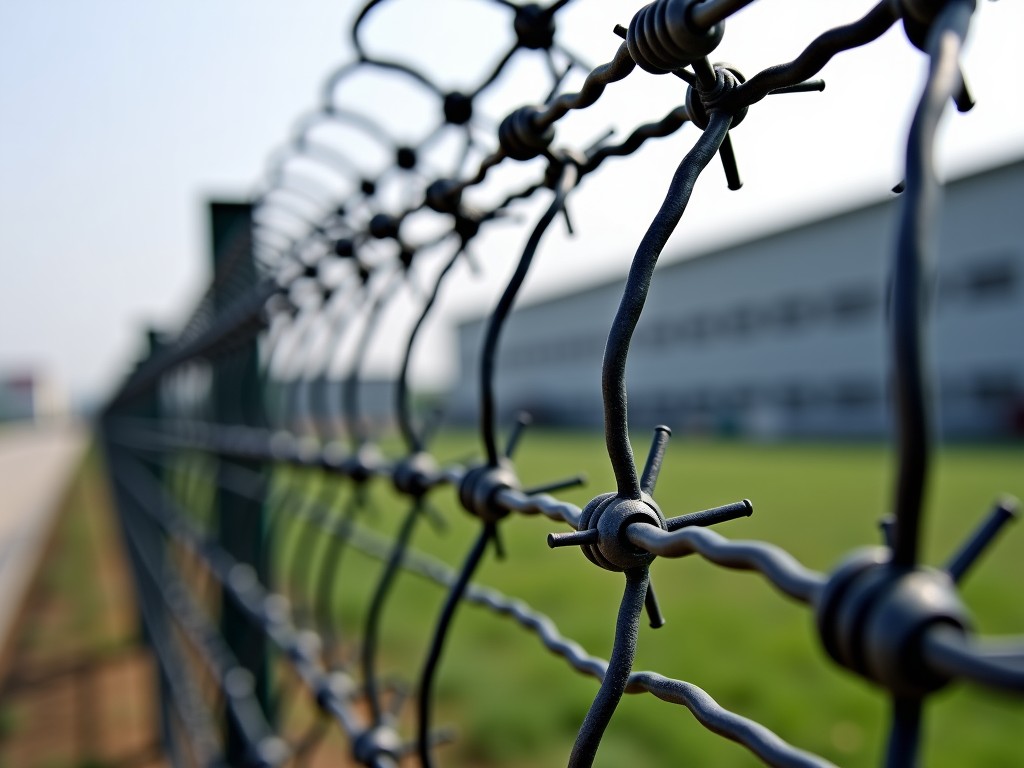
China Durable Double Barbed Wire Factory
Double barbed wire consists of two parallel steel strands helically twisted together, with sharp barbs formed on each strand at regular intervals. This configuration provides bidirectional resistance
China Durable Double Barbed Wire Factory
Double barbed wire consists of two parallel steel strands helically twisted together, with sharp barbs formed on each strand at regular intervals. This configuration provides bidirectional resistance to cutting and climbing, making it suitable for high‑security perimeters.
Product Overview
The factory produces double barbed wire using cold‑drawn low‑carbon steel wire with a nominal diameter ranging from 2.0 mm to 3.2 mm. Barbs are punched from the same wire stock, typically 12 mm to 18 mm long, and spaced 50 mm to 100 mm apart along the twist. Standard rolls are supplied in lengths of 50 m to 200 m, wound on steel or wooden cores.
Technical Specifications
| Parameter | Typical Value | Unit | Notes |
|---|---|---|---|
| Wire Diameter | 2.0 – 3.2 | mm | Cold‑drawn low‑carbon steel |
| Tensile Strength | 1200 – 1600 | MPa | Measured per ASTM A370 |
| Elongation at Break | 8 – 12 | % | At room temperature |
| Barb Length | 12 – 18 | mm | Symmetrical on both strands |
| Barb Spacing | 50 – 100 | mm | Adjustable per requirement |
| Twist Lay Length | 60 – 80 | mm | Distance for one full twist |
| Zinc Coating Weight | 180 – 270 | g/m² | Hot‑dip galvanization |
| PVC Coating Thickness (optional) | 0.3 – 0.5 | mm | Available on request |
| Roll Length | 50 – 200 | m | Standard; custom lengths possible |
| Core Diameter | 50 – 75 | mm | Steel or wooden |
Values are typical; custom specifications are available upon request.
Material Composition and Corrosion Protection
Base wire is produced from low‑carbon steel with carbon content below 0.12 %, ensuring good ductility for drawing and twisting. Hot‑dip galvanization applies a zinc layer that protects against rust in outdoor environments; optional PVC or polyester coatings add an extra barrier for aggressive chemical exposure.
Manufacturing Process
Wire rods are first drawn to the target diameter through a series of dies, then two strands are helically twisted at controlled tension to achieve the specified lay length. Barbs are formed by punching protrusions from each strand while the twist maintains alignment, followed by a final pass through a galvanizing bath or coating line.
Mechanical Performance
Typical tensile strength falls between 1200 MPa and 1600 MPa, providing resistance to cutting tools and impact forces. Elongation at break ranges from 8 % to 12 %, allowing the wire to absorb energy without brittle failure. Fatigue testing shows minimal strength loss after 10 000 load cycles at 70 % of ultimate tensile strength.
Typical Applications
- Perimeter security for industrial facilities: The double‑strand design raises the cutting force required to breach the barrier, delaying intrusion attempts.
- Livestock containment on farms: Barbs spaced at 75 mm prevent animals from pushing through while allowing visibility for herd monitoring.
- Infrastructure protection (railways, highways): High tensile strength resists vandalism and environmental stress, reducing maintenance cycles.
- Temporary construction site fencing: Lightweight rolls enable rapid deployment and retrieval, lowering labor costs.
Quality Assurance and Testing
Each batch undergoes tensile testing on a universal testing machine to verify strength and elongation, coating thickness measurement via magnetic probe for zinc layers, and 100 % visual inspection of barb uniformity and tip sharpness. Traceability labels record heat number, coating weight, and production date for every roll.
Customization Options
- Wire diameter: Adjustable from 2.0 mm to 3.2 mm to match load requirements.
- Barb length and spacing: Customizable from 10 mm to 20 mm length and 40 mm to 120 mm spacing.
- Coating type: Standard hot‑dip zinc, optional PVC, polyester, or powder‑coat finishes.
- Roll length and core: Lengths from 30 m to 300 m, steel or wooden cores with varying diameters.
- Tensile grade: Higher‑strength steel grades available for extreme‑security projects.
Packaging and Logistics
Finished wire is coiled tightly on reels, wrapped in stretch‑film to prevent moisture ingress, stacked on pallets, and secured with steel strapping for container loading. Each pallet bears a label with product code, length, weight, and handling instructions, facilitating smooth customs clearance and warehouse stacking.
Frequently Asked Questions
- Can the wire diameter and barb spacing be customized? Yes, both parameters are adjusted during the drawing and twisting stages to meet project‑specific security levels.
- What information is required before quotation? Required details include desired wire diameter, barb length, spacing, coating type, roll length, and any applicable standards (e.g., ASTM A121).
- Which materials are available for the core and coating? Steel or wooden cores are standard; zinc galvanization is default, with optional PVC or polyester coating.
- How is quality inspected before shipment? Each batch undergoes tensile testing, coating thickness measurement via magnetic probe, and 100 % visual barb inspection.
- What packaging methods are available for export? Wire is coiled on reels, wrapped in stretch film, placed on pallets, and secured with steel strapping for container loading.
- What is the typical production lead time? Lead time ranges from 10 to 25 working days depending on order size and customization complexity.
Contact for Inquiry
Engineers and procurement teams can submit detailed specifications or request a sample by visiting our contact page.