
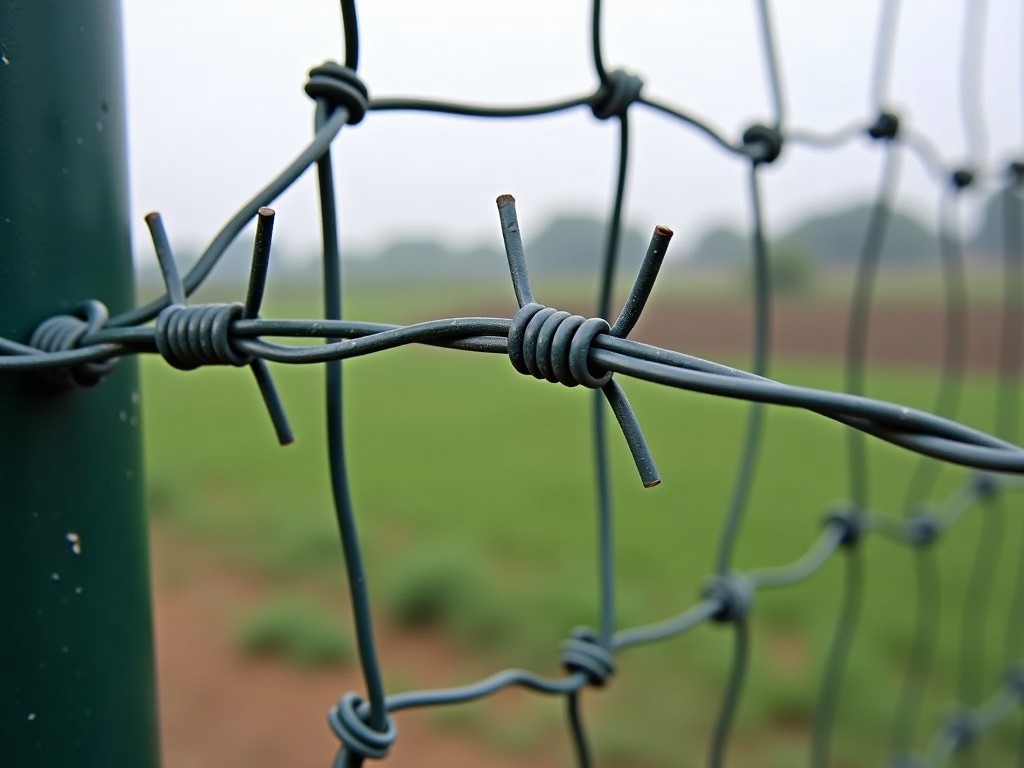
China Blade Razor Barbed Wire Fencing Supplier
The core wire is cold‑drawn to a diameter ranging from 2.0 mm to 3.5 mm, providing a tensile strength between 550 MPa and 700 MPa depending on the steel grade. Blades are formed from the same wire
Blade Razor Barbed Wire Fencing – Technical Overview
Product Description
The core wire is cold‑drawn to a diameter ranging from 2.0 mm to 3.5 mm, providing a tensile strength between 550 MPa and 700 MPa depending on the steel grade. Blades are formed from the same wire stock, with a thickness of 0.8 mm to 1.2 mm and a barb length of 15 mm to 25 mm. The pitch (distance between barbs) is typically set at 100 mm to 150 mm, which determines the number of sharp protrusions per linear meter.
When installed, the wire creates a continuous barrier where each barb acts as a mechanical deterrent, increasing the force required to cut or climb the fence. The geometry is optimized to concentrate stress at the barb tip, reducing the likelihood of successful intrusion without excessive material usage.
Material Composition
Base material is low‑carbon steel (SAE 1008/1010) selected for its ductility during drawing and forming processes. To enhance corrosion resistance, the wire undergoes hot‑dip galvanization delivering a zinc coating weight of 180 g/m² to 270 g/m². Optional PVC or PE overcoats can be applied, adding a polymer layer of 0.3 mm to 0.5 mm thickness in colors such as black, green, or gray.
The combination of galvanized steel and polymeric coating provides a service life exceeding 15 years in moderate atmospheric conditions, while maintaining the mechanical properties of the underlying steel.
Typical Specifications
| Parameter | Typical Value | Notes |
|---|---|---|
| Core Wire Diameter | 2.0 mm – 3.5 mm | Selected per load requirement |
| Blade Thickness | 0.8 mm – 1.2 mm | Uniform along length |
| Barb Length | 15 mm – 25 mm | Determines deterrent profile |
| Pitch (Barb Spacing) | 100 mm – 150 mm | Adjustable for density |
| Tensile Strength | 550 MPa – 700 MPa | Depends on wire grade |
| Zinc Coating Weight | 180 g/m² – 270 g/m² | Hot‑dip galvanized |
| PVC Overcoat Thickness | 0.3 mm – 0.5 mm | Optional, color‑customizable |
Manufacturing Process
Production begins with drawing hot‑rolled rod through a series of dies to achieve the target wire diameter, followed by straightening and spooling. The wire is then fed into a rotary forming head where blades are punched and barbs are simultaneously created in a single pass, ensuring consistent geometry.
After forming, the wire passes through a hot‑dip galvanizing bath at approximately 450 °C, producing a metallurgical bond between zinc and steel. If a polymeric overcoat is specified, the galvanized wire undergoes extrusion coating, cooled, and wound onto reels or coils under controlled tension to prevent deformation.
Each coil is inspected for diameter uniformity, barb alignment, and coating continuity before being released for packaging.
Applications and Suitability
Blade razor barbed wire is selected for perimeter security where a high deterrent effect is required with minimal material bulk. The sharp barbs increase the time and effort needed to breach the fence, making it suitable for facilities that cannot accommodate extensive concrete walls or electronic surveillance alone.
Typical installations include:
- Military bases and forward operating posts
- Correctional facility perimeters
- Industrial storage yards containing high‑value equipment
- Agricultural fields protecting livestock from predators
- Infrastructure sites such as substations and water treatment plants
The product’s flexibility allows it to be mounted on existing chain‑link fences, welded mesh panels, or concrete posts, adapting to varied site geometries without extensive civil work.
Quality Control and Testing
Dimensional verification is performed using laser micrometers on samples taken from each production batch, confirming wire diameter, blade thickness, and barb length within ±0.05 mm tolerances. Tensile strength is assessed via universal testing machines on specimens cut to standard gauge length.
Coating adhesion is evaluated by the ASTM D4541 pull‑off test, ensuring the zinc or polymer layer remains intact under mechanical stress. Visual inspection under 10× magnification detects any defects such as missing barbs, coating pinholes, or wire nicking.
All test results are recorded and available to customers upon request, providing traceability from raw material to finished coil.
Customization Options
Customers can specify coil length, inner diameter, and outer diameter to match handling equipment and installation constraints. Barb pattern can be altered from the standard single‑point design to a double‑point or reversed‑barb configuration, affecting the angular resistance profile.
Coating options include:
- Hot‑dip galvanization only
- Galvanization plus PVC overcoat (black, green, gray)
- Galvanization plus PE overcoat (custom colors available)
Additionally, the wire can be supplied pre‑straightened in lengths of 5 m to 10 m for rapid deployment on temporary barriers, or as standard coils of 25 kg to 50 kg for permanent installations.
Packaging and Logistics
Finished coils are wrapped in UV‑stabilized polyethylene film to protect against moisture and abrasion during transit. Each wrapped coil is placed on a wooden pallet with corner protectors and secured with polyester strapping, ensuring stability when stacked.
Standard pallet dimensions accommodate 20‑foot and 40‑foot shipping containers, with a typical load of 16 to 20 pallets per container depending on coil weight. Loading instructions are marked on each pallet to facilitate safe handling with forklifts or pallet jacks.
Frequently Asked Questions
| Question | Answer |
|---|---|
| Can the barb length and pitch be customized? | Yes, both barb length (15 mm–25 mm) and pitch (100 mm–150 mm) can be adjusted per project requirements. |
| What information is needed for a quotation? | Required details include desired wire diameter, coating type, coil weight or length, and any special barb pattern or packaging preferences. |
| Which steel grades are available? | Standard low‑carbon steel (SAE 1008/1010) is supplied; higher‑strength alloys can be offered upon request. |
| How is coating quality verified? | Coating weight is measured by gravimetric methods, and adhesion is tested per ASTM D4541 on random samples from each batch. |
| What is the typical lead time for an order? | Lead time ranges from 2 to 4 weeks for standard specifications; customized orders may require an additional week for tooling preparation. |
| Are samples available for evaluation? | Yes, sample lengths of 1 meter to 2 meters can be shipped at the customer’s expense, with freight collected or prepaid as arranged. |
Get Technical Details
For datasheets, custom configuration assistance, or a formal quotation, please reach out to our technical team.
Request Information