
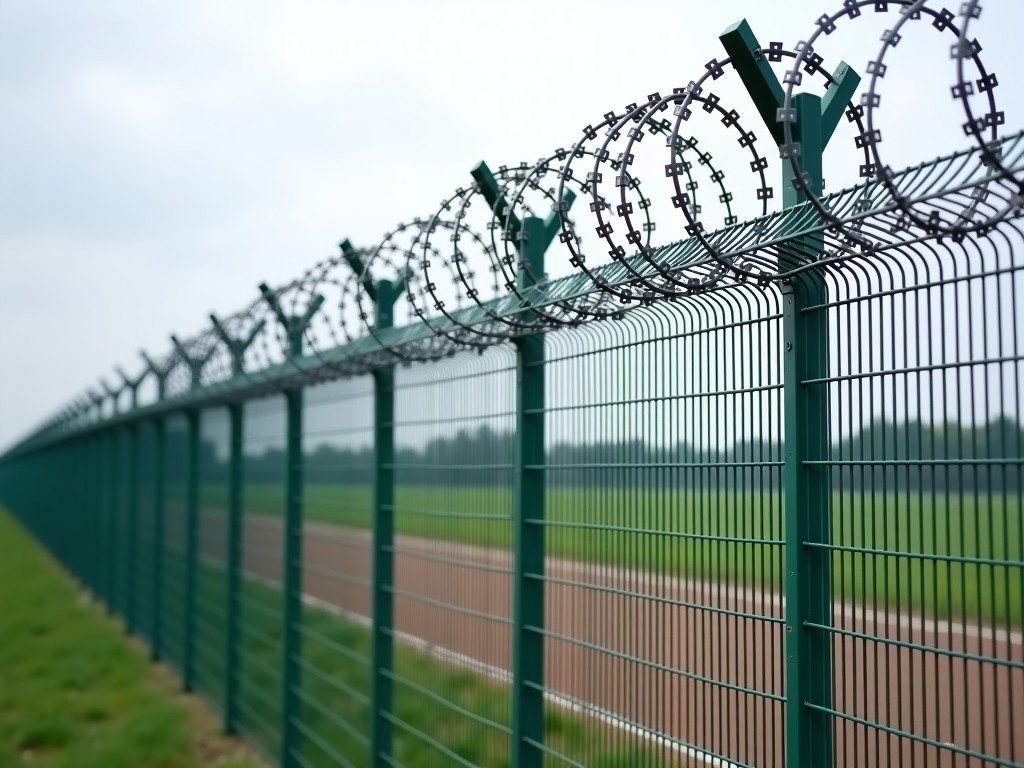
Ce Certified Fence With Razor Wire Supplier
CE marking indicates that the fence system has undergone conformity assessment against the relevant EU directives for construction products, specifically the Construction Products Regulation (CPR).
CE Certified Fence with Razor Wire – Technical Overview
CE marking indicates that the fence system has undergone conformity assessment against the relevant EU directives for construction products, specifically the Construction Products Regulation (CPR). This certification confirms that the product meets essential requirements for mechanical resistance, stability, and safety when installed as part of a perimeter security barrier.
Design and Material Composition
The primary structure consists of hot‑dip galvanized steel posts with a minimum zinc coating of 55 µm, providing corrosion resistance in accordance with EN ISO 1461. The mesh panel is fabricated from cold‑rolled steel wire, welded at intersections to form a uniform aperture, typically 50 mm × 50 mm or 75 mm × 75 mm, depending on the required climb‑resistance rating.
Razor wire is attached to the top edge of the mesh using stainless steel clips or integrated brackets. The wire profile can be flat‑wrap, concertina, or helical, each offering different tensile properties and deployment characteristics. All steel components receive a passivation layer after galvanization to inhibit white rust formation during storage and transport.
Mechanical Performance Characteristics
Tensile strength of the mesh wire is guaranteed at ≥ 550 MPa, measured per EN 10270‑1. The system is designed to resist a dynamic wind load of up to 2 kN/m², calculated according to EN 1991‑1‑4, ensuring stability in exposed coastal or high‑altitude sites.
Impact resistance is validated by a pendulum test delivering 50 J of energy to the mesh, with no permanent deformation exceeding 5 mm of deflection. The hot‑dip galvanized coating provides a minimum service life of 25 years in a C3 atmospheric environment, as defined by ISO 9223.
Installation Considerations
Posts are typically set in concrete foundations with a depth of 0.6 m for heights up to 2.4 m, increasing proportionally for taller barriers. The spacing between posts is dictated by the mesh panel width, commonly 2.5 m, to maintain panel rigidity and prevent sag under load.
Tensioning of the mesh is achieved via adjustable turnbuckles or tension wires running horizontally at the top and bottom edges, allowing precise pre‑load to accommodate thermal expansion. All fasteners are stainless steel grade A2‑70 to avoid galvanic coupling with the galvanized substrate.
Applications and Suitability
This fence system is selected where a combination of physical delay and psychological deterrence is required, such as correctional facilities, military installations, and substations protecting critical power infrastructure. The razor wire component increases the time required for an intruder to breach the barrier, providing security personnel with additional response time.
- Perimeter security for high‑value storage yards, where climb resistance and cut resistance are both essential.
- Border control points requiring rapid deployment and low maintenance under varying climatic conditions.
- Temporary event venues needing a reusable, modular barrier that can be assembled and disassembled without compromising structural integrity.
Quality Assurance and Testing
CE conformity is achieved through a factory production control (FPC) system audited by a notified body. Routine tests include tensile strength of mesh wires (EN 10270‑1), zinc coating thickness measurement (EN ISO 1460), and salt‑spray corrosion resistance (ISO 9227) for 500 hours with no red rust exceeding 10 % of the surface area.
Each batch undergoes visual inspection for weld integrity, wire diameter uniformity, and proper razor wire attachment. Documentation accompanying each shipment includes a Declaration of Performance (DoP) and traceability labels linking the product to specific production records.
Typical Technical Specifications
| Parameter | Typical Value | Reference Standard |
|---|---|---|
| Post height | 2.4 m (customizable up to 4.0 m) | Project dependent |
| Mesh wire diameter | 3.0 mm | EN 10218‑2 |
| Mesh aperture | 50 mm × 50 mm | Customizable |
| Razor wire type | Flat‑wrap, 0.5 mm blade thickness | EN 10270‑2 |
| Zinc coating (posts) | ≥ 55 µm | EN ISO 1461 |
| Tensile strength (mesh) | ≥ 550 MPa | EN 10270‑1 |
| Wind load resistance | 2 kN/m² | EN 1991‑1‑4 |
Customization Options
Height can be adjusted in 0.3 m increments by varying post length and adding intermediate stiffeners where required. Mesh aperture may be reduced to 25 mm × 25 mm for increased anti‑climb performance or enlarged to 100 mm × 100 mm for reduced material cost in low‑risk zones.
Razor wire configuration includes choice of blade profile (flat, helical, concertina), coating (PVC‑colored, stainless steel), and spacing between coils (typically 150 mm to 300 mm). Post finishes are available in powder‑coated RAL colors for aesthetic integration with surrounding architecture.
- Integrated anti‑cut sensors embedded within the mesh for alarm triggering.
- Bottom tension wire with ground spikes for installation on uneven terrain.
- Removable razor wire cassettes facilitating periodic replacement without dismantling the fence.
Frequently Asked Questions
- Can dimensions be customized? Yes, post height, mesh aperture, and razor wire layout are all adjustable to meet project‑specific security levels and site constraints.
- What information is required before quotation? Required details include desired fence height, total linear length, soil conditions for foundation design, and any specific coating or color preferences.
- How is quality inspected? Each production lot undergoes dimensional checks, coating thickness measurement, tensile testing on wire samples, and visual inspection of welds and razor wire attachment.
- What packaging methods are available? Panels are bundled with protective edge guards, stacked on pallets, and wrapped in UV‑stabilized polyethylene film; razor wire coils are sealed in corrosion‑inhibiting tubes.
- What is the typical production lead time? Standard lead time is 4‑6 weeks after receipt of technical drawings and confirmation of custom options; expedited schedules are available upon request.
Next Steps
For detailed datasheets, CAD models, or a formal quotation, please contact our technical sales team. Provide the project specifics outlined above to receive a tailored solution that meets CE compliance and your security objectives.
Request Technical Consultation