
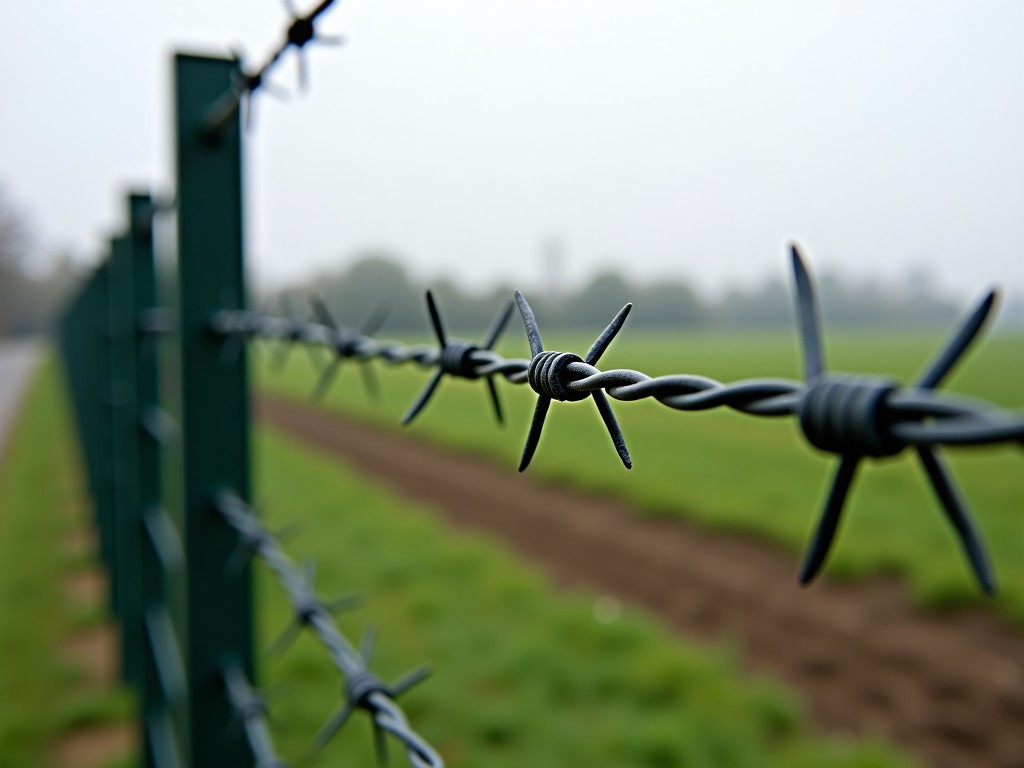
Best Price Fencing Barbed Wire For Sale
Fencing barbed wire consists of a steel core wire twisted with regularly spaced barbs that protrude at angles to create a deterrent surface. Its primary function is to impede unauthorized crossing by
Best Price Fencing Barbed Wire for Sale
Fencing barbed wire consists of a steel core wire twisted with regularly spaced barbs that protrude at angles to create a deterrent surface. Its primary function is to impede unauthorized crossing by causing discomfort or injury upon contact, making it suitable for livestock containment, perimeter security, and temporary barrier applications.
The core wire diameter, expressed as gauge, directly affects tensile strength and weight per unit length. Common gauges for agricultural fencing range from 10 (≈3.4 mm) to 12.5 (≈2.0 mm); lower gauge numbers indicate thicker wire that can withstand higher tension loads before yielding.
Protective coating, usually zinc applied by hot‑dip galvanizing, is measured in grams per square meter (gsm). A coating of 100 gsm provides roughly 8 µm thickness, while 275 gsm offers about 22 µm, significantly extending service life in corrosive environments.
Technical Specifications
| Parameter | Typical Range | Units |
|---|---|---|
| Core wire gauge | 10 – 12.5 | Gauge (lower = thicker) |
| Tensile strength | 550 – 700 | MPa |
| Zinc coating weight | 100 – 275 | gsm |
| Barb spacing | 75 – 150 | mm |
| Barb length | 15 – 25 | mm |
| Roll length | 200 – 500 | m per roll |
Selecting a gauge balances handling ease with load capacity; thicker wire reduces sag over long spans but increases installation effort. Coating weight should match expected exposure: 100 gsm suffices for dry inland sites, while coastal or industrial zones benefit from 200 gsm or higher.
Material and Coating Options
The core wire is typically produced from low‑carbon steel (grades such as SAE 1008) that is cold‑drawn to the target diameter, then optionally stress‑relieved to achieve the desired tensile strength. High‑tensile variants use alloy additions (e.g., manganese) to reach 700 MPa without excessive brittleness.
Galvanization can be performed by hot‑dip immersion, where the wire passes through a molten zinc bath at ~450 °C, producing a metallurgical bond, or by electro‑galvanizing, which deposits a thinner, more uniform zinc layer via electric current. Hot‑dip generally yields higher coating weights and better adhesion for harsh environments.
Design Features that Affect Performance
Barb spacing determines the frequency of protrusions; tighter spacing (≈75 mm) creates a more continuous barrier, while wider spacing (≈150 mm) reduces material weight and eases handling. Barb length influences penetration depth; longer barbs increase deterrent effect but also raise the risk of snagging on clothing or wildlife.
The twist direction of the double‑helix core (usually right‑hand) affects how the barbs sit relative to the wire axis. A consistent twist ensures uniform barb orientation, which is important for predictable performance under tension and for proper installation with staples or tensioners.
Typical Applications and Why They Suit
- Livestock pasture fencing – the barbs discourage animals from pushing against the wire, reducing wear on posts and maintaining containment with lower tension requirements.
- Perimeter security for storage yards – the painful deterrent delays intruders, giving security personnel additional response time; the wire can be mounted on top of chain‑link or welded mesh for added difficulty.
- Temporary construction site barriers – rolls are lightweight, easy to unroll and secure with staples, providing a low‑cost solution that can be removed and reused after project completion.
- Wildlife management exclusion – spaced barbs deter larger animals from entering sensitive areas while allowing smaller species to pass, useful in agro‑forestry buffers.
Quality Control and Testing
Each production lot undergoes tensile testing on a calibrated universal testing machine; specimens are gripped at both ends and pulled until fracture, recording ultimate tensile strength and yield point. Results must meet the minimum specified for the ordered gauge.
Coating weight is verified by the weigh‑strip method: a known length of wire is stripped of zinc, the mass difference divided by the surface area yields gsm. Visual inspection checks for uniform barb formation, absence of cracks, and proper twist tightness.
Pricing Factors and Value Considerations
Price per kilogram scales with wire diameter because thicker wire consumes more raw steel; a 10‑gauge roll can be 20‑30 % heavier than a 12‑gauge equivalent of the same length. Coating weight adds cost proportionally; each additional 50 gsm of zinc increases material expense by roughly 5‑7 %.
Order volume influences unit price through economies of scale in drawing, galvanizing, and packaging. Full‑truckload shipments reduce handling overhead, while split loads may incur additional palletizing fees. Buyers should request a quote that specifies gauge, coating, roll length, and packaging to obtain an accurate landed cost.
Customization and Ordering
Customers can specify any combination of gauge (10‑12.5), zinc coating (100‑300 gsm), barb spacing (50‑200 mm), barb length (10‑30 mm), and roll length (100‑800 m). Custom twists or plastic‑coated overlays are available upon request for specialized applications.
Packaging options include standard coil rolls wrapped in UV‑stabilized polyethylene, wooden reels for longer lengths, or palletized bundles with corner protectors. Labeling includes batch number, gauge, coating weight, and length for traceability.
Frequently Asked Questions
- Can the wire be supplied with a PVC coating over the zinc?
Yes, a PVC overcoat can be applied after galvanizing to provide additional abrasion resistance and color coding; thickness typically ranges from 0.2 mm to 0.5 mm. - What information is needed to receive a quotation?
Please provide required gauge, coating weight, barb spacing, barb length, roll length, quantity, and any packaging or labeling preferences. - Is the wire suitable for direct burial?
For burial applications, a heavier zinc coating (≥250 gsm) or a polymer‑coated variant is recommended to mitigate soil‑induced corrosion. - How are the barbs formed to ensure uniformity?
Barbs are created by cutting and twisting pre‑formed protrusions on the wire before the final double‑helix twist; in‑line optical gauges monitor spacing and length during production.
Contact for Quotation
To discuss your specific fencing requirements and obtain a detailed, no‑obligation quote, please reach out to our sales team.